Argentina’s Football Roots Are at Risk of Privatization
- Alex Caring-Lobel
Argentina’s biggest football stars, from Maradona to Messi, got their start in the country’s ubiquitous neighborhood sports clubs. These community centers urgently need government support, not the ruthless privatization on offer from far-right president Javier Milei.
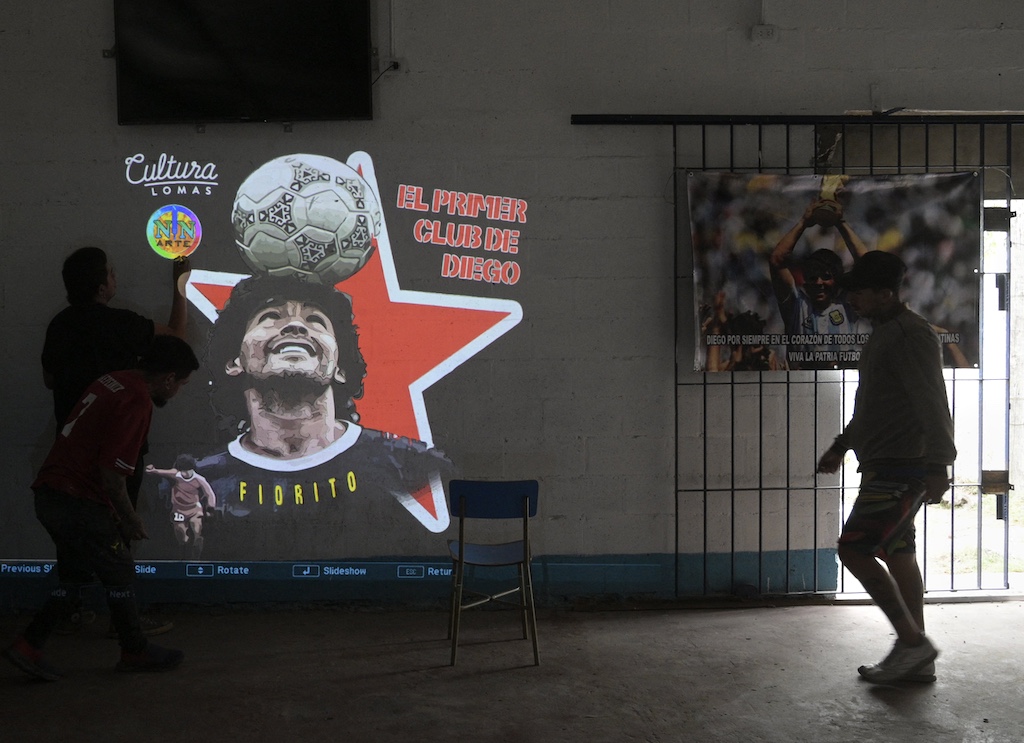
A mural of Diego Maradona on a wall of his childhood club, Estrella Roja, in Villa Fiorito, Buenos Aires province, Argentina, on November 25, 2021. (Juan Mabromata / AFP via Getty Images)
No other city in the world has as many football stadiums as Buenos Aires. It’s central urban area alone is home to eighteen that can seat over ten thousand spectators. If you count the whole metropolitan area, that figure doubles to thirty-six. In the municipality of Buenos Aires, where three million people live, there are fifty-four public fields where football can be freely played at no cost. The number of private amateur fields is impossible to determine precisely, but it’s estimated to be more than four hundred.
In Argentina, football has long since ceased to be a sport to become an organizing principle of society. Here football — like Peronism, like truth — is nothing other than a field of struggle.
That’s why it’s no coincidence that one of the first aims of the anarchocapitalist administration of Javier Milei has been football — or rather, the civil organizations that run Argentina’s football clubs. The intention is to replace them with corporations so that the clubs no longer belong to their members, who vote and elect leaders, but to Sports Corporations (Sociedades Anónimas Deportivas, or SAD), for-profit companies run by boards of directors.