Poland’s Milk Bars Live On After Communism
In Poland, postwar Communist rule has few defenders. But state-subsidized eateries known as milk bars, designed under state socialism to free people from “kitchen slavery,” continue to thrive today.
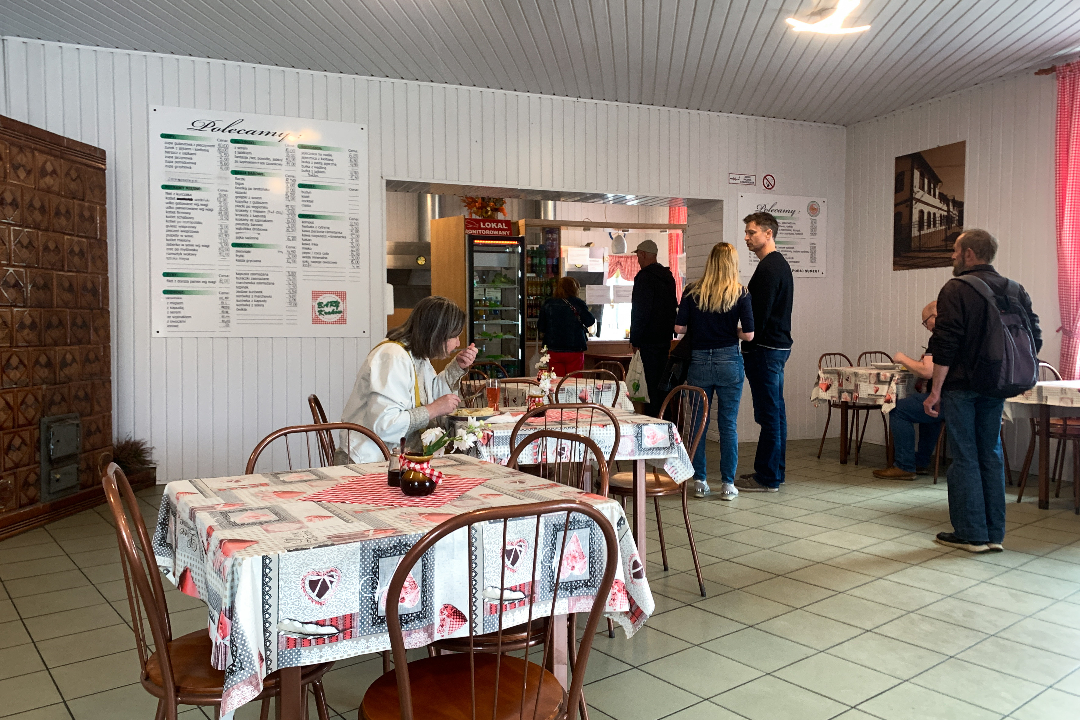
A milk bar in Krakow, Poland, photographed on May 24, 2022. (Jakub Porzycki / NurPhoto via Getty Images)
In the center of the Polish capital, Warsaw, is a street called Nowy Swiat — New World Street. Built in the eighteenth and early nineteenth centuries in a neoclassical style and reconstructed very meticulously to something like its original appearance after Warsaw’s near-total destruction by Nazi Germany in 1944, it is the very heart of bourgeois Poland, the place where those who won out in the “transition” to capitalism after 1989 can go and drink at expensive bars, buy overpriced goods of various kinds, and generally promenade along its wide pavements toward the tourist trap of the Old Town. If you were walking down it for the first time, you would notice the wealth, but you would almost certainly miss a little place called Bar Familjny — Family Bar — an unassuming shop unit next to a “French-style” café called Croque Madame and opposite Thai Bali Spa. Walk inside it, and you’ll be beamed into another zone entirely from the interchangeable streetscape of contemporary Euro-capitalism.
Bar Familjny is a typical, if unusually centrally located, example of what is called in Poland a bar mleczny, a milk bar. This term has been used occasionally in English, usually in the postwar years, to refer to nonalcoholic bars aimed at the underage as a way of encouraging them not to develop a taste for booze. A Polish bar mleczny is a little different; in its quiet way, it is, as an institution, the greatest survivor of the frequently mocked but strangely enduring legacy of state socialist planning for proletarian eating.
The first thing you’ll notice — perhaps helped by a translation app, as tourists and monolingual English speakers are not among Familjny’s usual clientele — is that the food is outrageously cheap. Once you’ve worked out what dishes you want, you queue up to a little niche. You ask here for what you want, and you’ll be given a bit of paper. You take this to a larger niche, from which you can see the kitchen, and you give it to a uniformed staff member, who would usually be middle-aged or older. They will dollop the particular parts of your meal onto your plate. Then you sit down, and you eat it, and when you’ve finished, you put the plate and your cutlery onto a rack — there is nothing so servile as waiting staff. There are some drawbacks to this system, to be sure. I have only once or twice been in a milk bar that had a toilet, and because at lunchtime especially there are always a lot of people queuing, you are not encouraged to linger. You eat, and then you go home or back to work — but you’ll have been able to have a decent three-course meal of soup, a main course, and a slice of cake for the equivalent of, at the very most, £5, in a country where the cost of living is almost comparable to Britain’s.