How the West Destroyed Congo’s Hopes for Independence
In 1960, Patrice Lumumba became the prime minister of newly independent Congo. His close ally Andrée Blouin describes how Belgium and the US conspired to oust Lumumba and impose Mobutu’s kleptocratic dictatorship on the Congolese people.
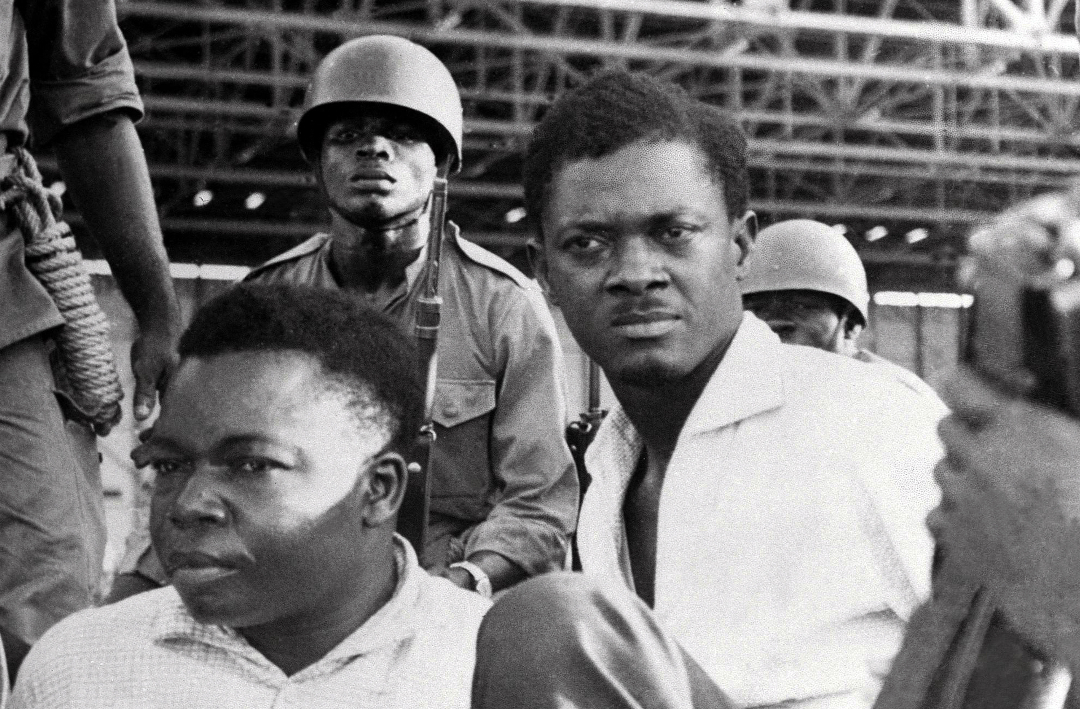
A December 1960 photo shows soldiers guarding Congolese prime minister Patrice Lumumba (right) Joseph Okito (left), vice president of the Senate, upon their arrest in Léopoldville (now Kinshasa). (AFP Photo / Stringer via Getty Images)
The burden that Patrice Lumumba, prime minister of the Republic of the Congo, assumed was an awesome one. On his young, slim shoulders — he was then thirty-four years old — rested the heavy weight of a country of six provinces containing 14 million souls speaking three principal languages — Lingala, Swahili, and Kikongo — and an uncounted number of dialects.
He inherited a scene set for disaster. Government officials and businesspeople were resigning. People in the professions were leaving en masse. The Belgians had not trained replacements. There were few people in any field who were capable of taking responsibility. The workforce was made up only of copying clerks, blue-collar workers, and laborers. The most basic services began to go to pieces. As the Belgians had hoped.
In Léopoldville, on the eve of independence, out of a population of 350,000, there were at least 100,000 unemployed. This number was to swell “miraculously” at the proclamation of independence, and the people demanded “work and a good salary, at once.” How was the new government to wave a magic wand and, within two days after the proclamation, find a solution for the catastrophe that the Belgians had been preparing for eighty years?