Is Iran Next?
Whatever restraints once existed on Israel’s behavior are long gone. Benjamin Netanyahu is now setting his sights on Iran — the question is to what extent President Donald Trump will back him.
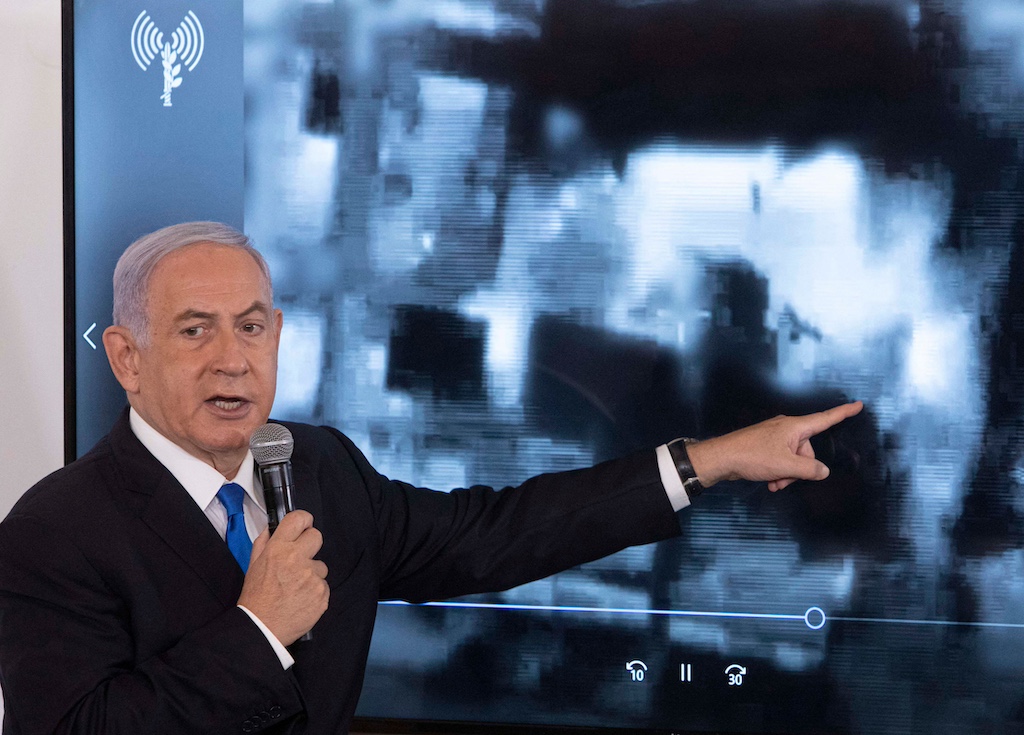
Israeli prime minister Benjamin Netanyahu gestures as he shows a slideshow during a briefing at the Hakirya military base in Tel Aviv, Israel, on May 19, 2021. (Sebastian Scheiner / AFP via Getty Images)
Pro-Israel triumphalists are celebrating a trifecta: in the course of a little over a year, Israel has felled or significantly set back its three most troublesome enemies: Hamas, Hezbollah, and Syria’s Bashar al-Assad. Another enemy, Iran, has been brought low by Israeli missile attacks, the assassination of Hamas leader Ismail Haniyeh in Tehran, and a Revolutionary Guard commander in Damascus. Its Iraqi Shia militia allies have reportedly promised, at least temporarily, to cease attacks on Israel.
Israeli military sources claim that its strikes inside Iran (precipitated by an Iranian missile assault on Israel) dismantled much of its air defense systems. These security officials note that this was a key mission: to eliminate Iran’s air defenses in preparation for a future all-out assault on its nuclear program. The sources estimate it will take a year or more for Iran to repair the current damage and restore its capabilities. During this period, it will be most vulnerable, and an attack would be most optimal from an Israeli point of view. That would be the time frame within which such an assault would be expected.
In its weakened state, both Israeli leaders and Trump security advisers are urging such an attack on Iran. Former Israeli defense minister, Yoav Gallant, traveled to Washington, DC, last month. He lobbied US officials, telling them this is “a window to act against Iran.” He favored either an Israeli or preferably a joint US-Israeli operation against Iran’s nuclear infrastructure.