How Violent Neo-Nazis Resurfaced in Wartime Russia
The war in Ukraine has given new prominence to Russia’s neo-Nazis, as official media echo their xenophobic claims. No longer afraid of repression, such groups circulate videos of spectacular street violence among hundreds of thousands of followers.
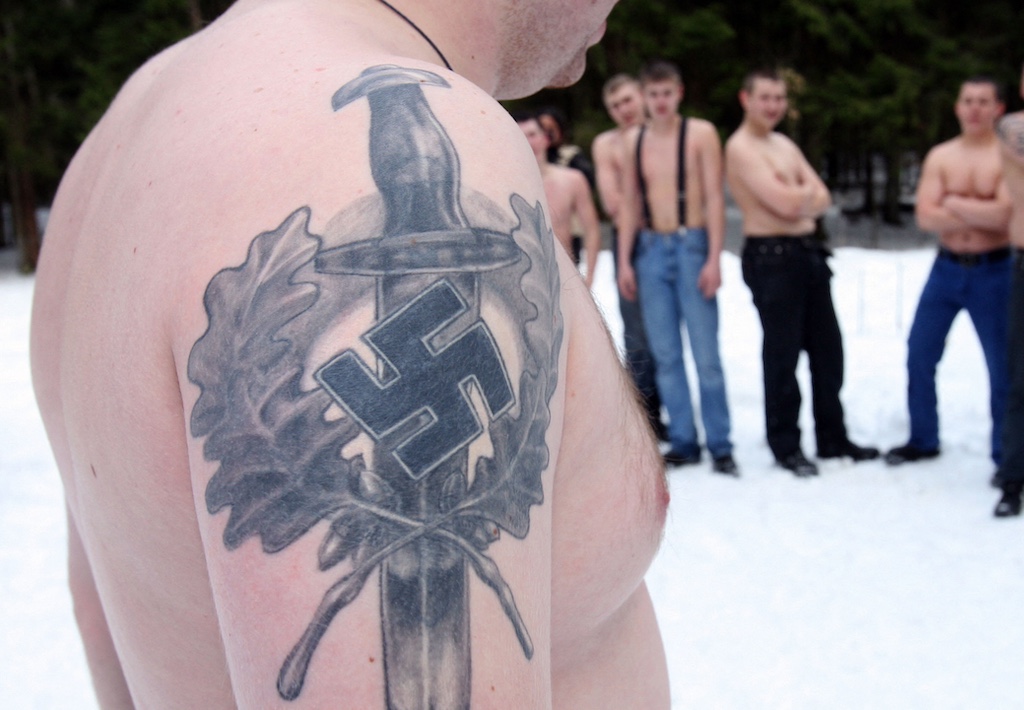
Members of Russian far-right neo-Nazi group Slavic Union outside Moscow on March 10, 2008. (Vassily Maximov / AFP via Getty Images)
The neo-Nazi subculture first emerged in Russia in the mid-1990s but remained marginal until the early 2000s. At the time, more traditional forms of neo-Nazi organization had gained greater popularity, mimicking the structures of fascist movements from the first half of the twentieth century: political parties with hierarchical structures and paramilitary units. The most successful among them was Russian National Unity (RNU). At its peak in the mid-1990s, the organization had up to 15,000 active members, with chapters operating in major cities. In some areas, fascists managed to establish connections with local authorities. However, due to internal splits, conflicts with official structures, and changes in Russia’s political system, the organization disintegrated by the early 2000s.
The decline of organized fascist movements coincided with the rise of the neo-Nazi skinhead subculture. Like most youth subcultures in the post-Soviet space, Russian neo-Nazi skinheads imitated the style and ideology of Western neo-Nazi skins, obtaining information about them from foreign media. The use of Nazi symbols and terminology from German Nazism provoked outrage among ordinary Russians, as almost every family had lost relatives during the Great Patriotic War, as World War II is known in Russia.
At the same time, this shock value helped draw attention to the movement and, as a result, increase its numbers. Furthermore, the radical rejection of the Soviet past, which was part of the dominant ideology in post-Soviet Russia, created opportunities for World War II revisionism. By 2003, according to the Ministry of Internal Affairs, there were 15,000-20,000 skinheads in Russia, and by 2006, Interior Minister Rashid Nurgaliyev claimed that the police were aware of 98,000 “extremist” youth.