The US Blockade Against Cuba Is an Act of War
For sixty years, the United States’ blockade against Cuba has worked to hinder the island’s development and prevent it from trading even with third countries. It’s time Washington stopped its cruel punishment of its smaller neighbor.
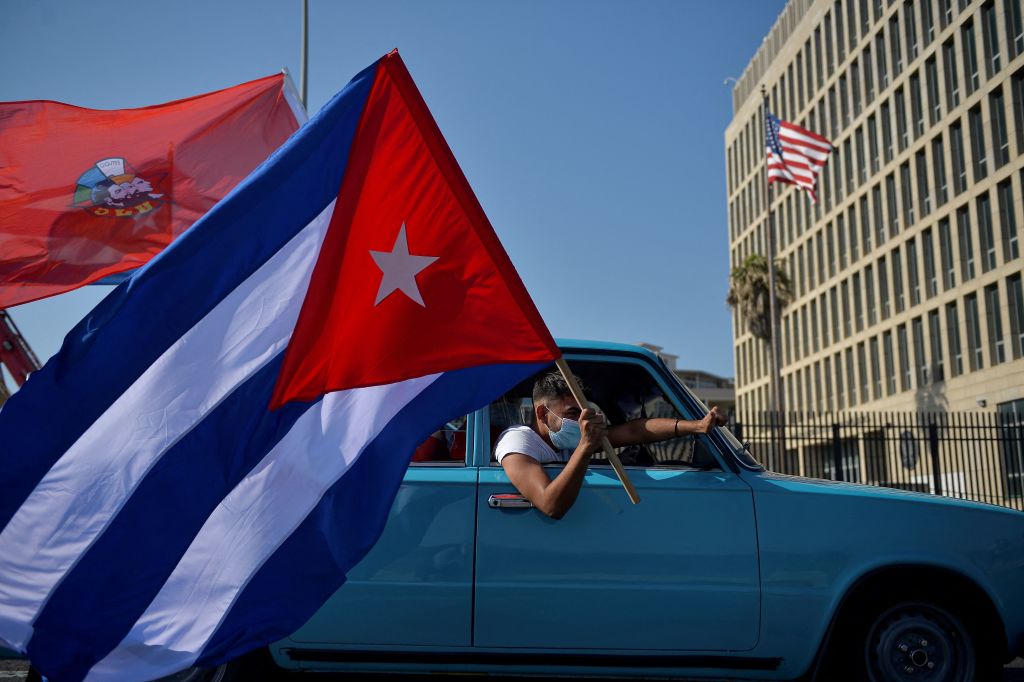
Cubans drive past the US embassy during a rally calling for the end of the US blockade. (YAMIL LAGE/AFP via Getty Images)
On February 25, a top official in Joe Biden’s administration said US sanctions imposed on Russia following the invasion of Ukraine were also intended to hit Cuba, Venezuela, and Nicaragua. That month marked the sixtieth anniversary of the US blockade of Cuba, introduced in February 1962 by President John F. Kennedy’s Embargo on All Trade with Cuba. The embargo of Cuba constitutes the longest and most comprehensive set of sanctions in modern history. It is not merely a legal or a bilateral issue, as proponents claim. It is a key instrument in the US toolkit to pursue regime change on the island. It is an act of war, a violation of human rights designed to obstruct Cuban development, to undermine its example as a revolutionary alternative, and to intentionally cause suffering among the Cuban people.
While the pretext for US actions against Cuba has changed over six decades, the objectives have not. The goal was made clear in an April 1960 memorandum authored by Lester D. Mallory, US assistant secretary of state, who advised measures “to weaken the economic life of Cuba . . . to bring about hunger, desperation and overthrow of government.” The CIA had already launched operations against Cuba’s revolutionary government in late 1959, orchestrating acts of terrorism and sabotage and recruiting agents on the island. Given the hardship and heartbreak caused by these actions, clearly the human rights of the Cuban population were of no concern. Although the revolutionary government had already carried out the Agrarian Reform of 1959, confiscating unproductive plantations over one thousand acres and expropriating seventy thousand acres from US sugar companies in January 1960, Mallory did not frame the proposed policy as retaliation for nationalization or a means to pressure the government over the issue of compensation — a claim that was only later made to justify the US embargo in international law. The concern expressed was “communist influence.”
On April 16, 1961, this influence was confirmed when, on the eve of the Bay of Pigs Invasion, Fidel Castro announced, “What [they] cannot forgive us for is . . . that we have carried out a socialist revolution right under the nose of the United States!” The early measures of the revolutionary state rapidly encroached on private interests, domestic and foreign, dismantling the economic and political institutions of the old Cuba, a US client state, and building new institutions, power structures, and social relations, as well as adopting a centrally planned socialist economy and setting up “organizations of the masses.” While it was the threat of communism that made Cuba the target of US sanctions, the adoption of socialism and the shift to trade with the USSR and the socialist bloc enabled Cuba to survive the potentially devastating impact of the US blockade.