Marine Le Pen Sets the Agenda for France’s Government
In the name of constructive opposition, Marine Le Pen has issued her conditions for tolerating new prime minister Michel Barnier. Her party wants to show it’s ready for high office — but is vaguer about its stance on Barnier’s austerity plans.
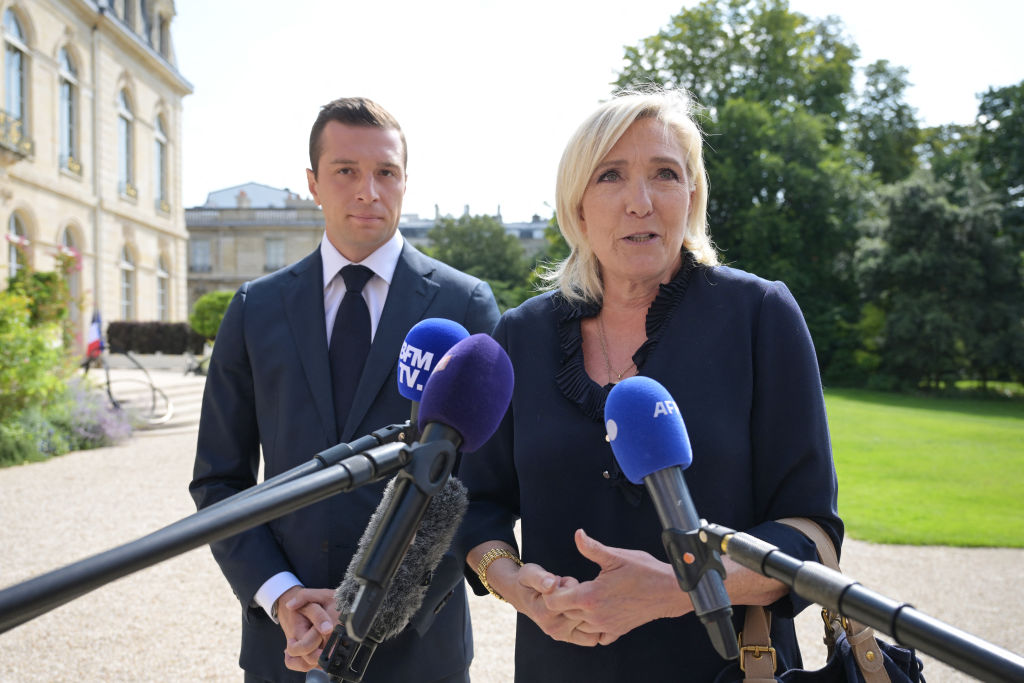
President of Rassemblement National Jordan Bardella stands next to Marine Le Pen as she speaks to the press at the Elysee presidential palace in Paris, on August 26, 2024. (Bertrand Guay / AFP via Getty Images)
Marine Le Pen has often posed as the sole voice of the ignored French people — and the enemy of the political establishment of “either left or right.” Yet if corporate media often lazily label her a “populist,” this week Le Pen took another step into the institutional mainstream. Responding to the first policy speech by new prime minister Michel Barnier, a veteran conservative, she insisted that he should have his “chance to govern.” Le Pen committed not to vote out former European Union official Barnier’s minority government, saying she rejected the “childish posturing” of those on the Left who sought to immediately force Emmanuel Macron’s pick from office. As she put it, “More than ever, we want to be a constructive force, and a possible new government as soon as possible.”
For the next several months, such tolerance should be enough to keep Barnier in office. His Républicains are today France’s fifth-largest party, and even in coalition with Macron’s allies, they are dozens of seats short of a parliamentary majority. Macron nonetheless appointed Barnier to head the government and push through a budget (mooting a huge €40 billion in spending cuts for 2025), while facing down the coalition that did best in this summer’s snap election, the left-wing Nouveau Front Populaire (NFP). Denied a chance to try and form a government, even the NFP’s more center-left elements were unwilling to join forces with Barnier, whose government will instead rely on Le Pen’s more or less passive consent. By declaring that she won’t join the NFP in a no-confidence vote, Le Pen can keep Barnier on a tight leash — while also showing her responsibility to middle-class voters and potential business allies.
Barnier’s government is surely among the most conservative in recent decades. His pick for interior minister, Bruno Retailleau, spent much of his career in the hard-right Mouvement pour la France and was explicitly chosen as a signal of the government’s firmness on “restoring order.” As France’s new “top cop,” Retailleau provoked controversy this weekend after he questioned whether the “rule of law” is truly “untouchable or sacred.” He later walked back the comments, though not his statement that France would benefit from a (currently unconstitutional) referendum on migration. On the political right, the idea that Le Pen’s Rassemblement National is singularly extreme — the kind of anathema that rallied left-wing and some centrist voters against it in July’s runoff elections — has clearly taken a knock. This week, after new economy minister Antoine Armand implied that Le Pen’s party does not belong to the “republican arc” of democratic parties that he would consult on the budget, Barnier slapped him down — even phoning Le Pen to reassure her.