Easington Under Occupation
This week 40 years ago, police from across the UK descended on the mining town of Easington to quash the historic miners’ strike. The police left, but deprivation from deindustrialization and neglect remain.
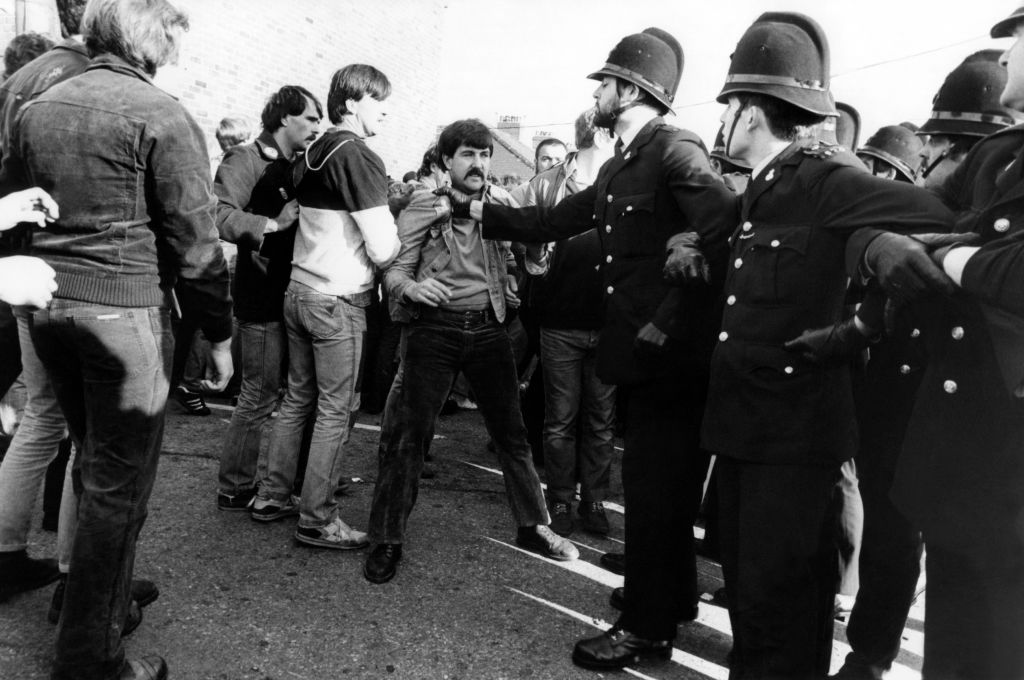
Police and workers clash on August 28, 1984, in Easington Colliery, United Kingdom. (NCJ Archive / Mirrorpix / Getty Images)
Easington: a small, tight-knit community that stagnated after the closure of County Durham’s last pit in 1993. It’s a riches-to-rags tale familiar to anyone who lives in a former mining town — the state-mandated violence, police brutality, and community spirit seen there were no different than in any other pit village across the country. Yet as we mark forty years since the events of 1984 and ’85, something about this particular colliery utterly encapsulates the political intent, local response, and lasting legacy of this period in the UK’s national history.
Situated less than two miles from the beach, Easington was one of several large pits that had been mechanized in the late 1960s. As smaller mines across County Durham were closed, workers flocked to Dawdon, Easington, Horden, and Blackhall and retrained to keep up with the rapidly developing industry. The result? A community of highly skilled workers who knew when to move with the times and when to get organized.
“I used to work at one of those catalog companies in Sunderland,” recalls Heather Wood, an activist and former Labour councilor from Easington Colliery. “That’s when I had my first clash with management. I wanted to go out on a weekend, but our bosses were making us work seven days a week. So I went down to the warehouse where there was a union, got advice from them, and called everyone at lunchtime. I was about eighteen then. We won the right to say we didn’t want to work overtime, we didn’t want to work weekends. That just spurred me on.”