How Two Leftist Scholars Saved Nietzsche’s Archive
In postwar Europe, Friedrich Nietzsche was seen as an intellectual proto-Nazi. A new book explains how two antifascist Italian academics — one of whom was a communist — fought to recover the “real” Nietzsche for the Left.
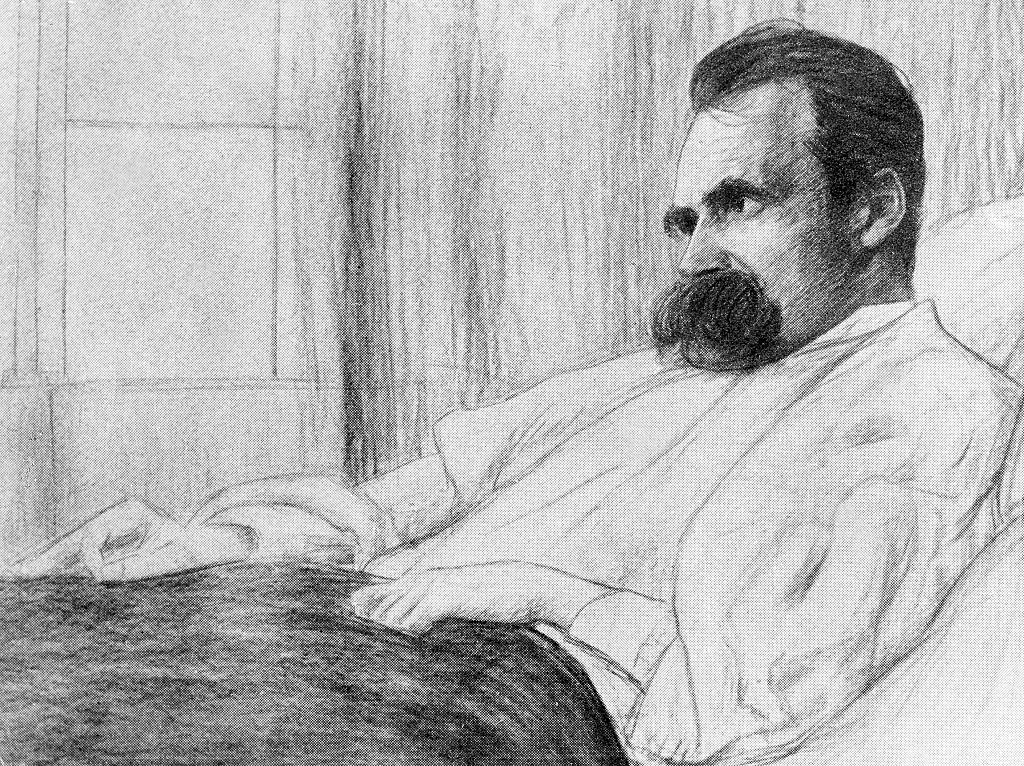
An 1899 charcoal drawing of Friedrich Nietzsche by Hans Olde. (ullstein bild via Getty Images)
What I hate [in the Revolution] is . . . the so-called “truths” that give the Revolution its lasting effectiveness, attracting everything flat and mediocre. The doctrine of equality! . . . But no poison is more poisonous than this: because it seems as if justice itself is preaching here, while in fact it is the end of justice. — Friedrich Nietzsche, Twilight of the Idols
For a person of the Left, it is often hard to love Friedrich Nietzsche. Or, more accurately, as a leftist lover of Nietzsche, one is often required to park one’s commitments and either skim his work or look the other way for certain passages. Some hardier souls have attempted to argue that black is white by explaining or reinterpreting Nietzsche’s more obviously conservative views. But ultimately, there is no way around it: Nietzsche hated equality. And insofar as a leftist politics advocates for equality, there is no reconciliation possible. As a philosopher committed to radical, aristocratic individualism, he was a vehement critic of every kind of egalitarianism.
Which is why the story told by Philipp Felsch in How Nietzsche Came in From the Cold: Tale of a Redemption is a compelling and fascinating one. Felsch tracks the contradictory reception of Nietzsche’s work across the second half of the twentieth century. In the immediate postwar period, he was known as the “favorite philosopher” of both Adolf Hitler’s National Socialists and Benito Mussolini’s Fascists. Despite this, in a space of just a few decades, French philosophers associated with the New Left and the May 1968 revolt had come to embrace Nietzsche, finding in his writings ideas that would come to define subsequent movements in so-called continental philosophy, including poststructuralism and deconstruction.