Voting for Neoliberalism With Iranian Characteristics
Sanctioned, isolated, and living under a neoliberal state seemingly out of options, Iranians go to the polls today.
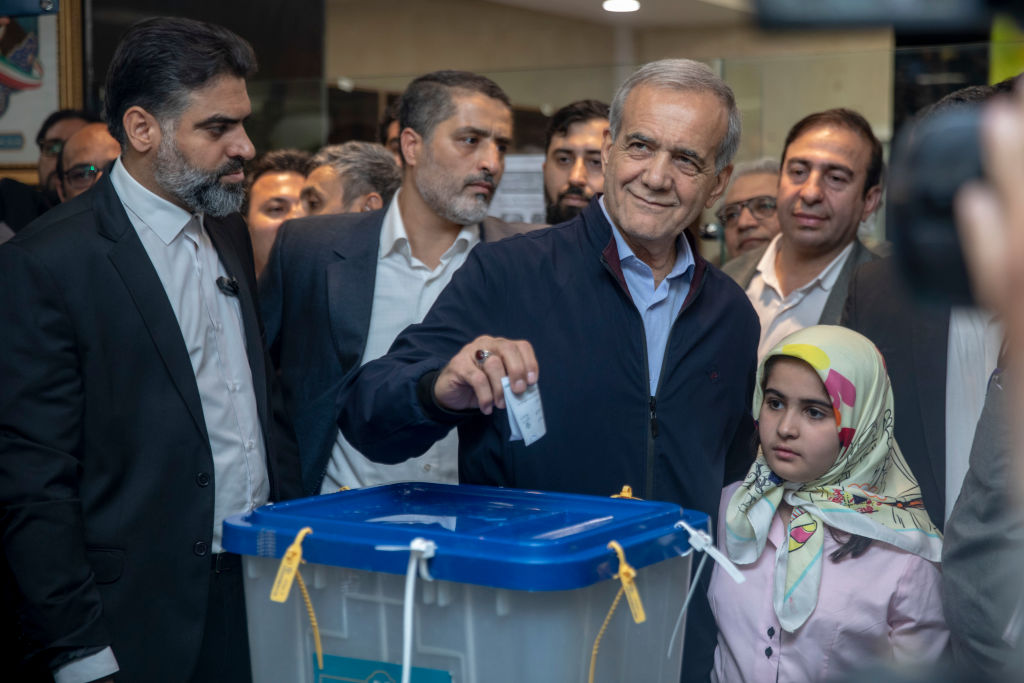
Iranian reformist presidential candidate Masoud Pezeshkian votes on June 28, 2024, in Tehran, Iran. (Majid Saeedi / Getty Images)
As Iran goes to the polls on June 28 for an emergency 2024 election to replace president Ebrahim Raisi, who was killed last month in a helicopter crash, the country remains constrained by US sanctions and its own domestic elite. Sanctions have led Iran, an oil rentier state isolated from the world market, to develop a shadow economy dominated by paramilitary patronage networks that have future-proofed the state but also Iranian politics for the foreseeable future.
The Left exited the stage in Iran long ago. What remains are two failed visions of neoliberalism, conservative and reformist, that leave Iran in an acute state of political gridlock. What will bring this long stalemate to an end is the central question of this election. The front-runners all belong to blocs lacking compelling answers.
Sanctions and the Domestic Sphere
Since its inception, the domestic politics of the Islamic Republic have been shaped by American imperialism and the revanchism of a US political and military class who “lost” — and were humiliated by — Iran during the last decade of the Cold War. The United States backed Saddam Hussein in his invasion of Iran, and Tehran was in the sights of the neocons during the war on terror. But it was on the last day of 2011 that the Islamic Republic entered a financial trap that has shaped the contours of political life ever since, foreclosing the very horizon of political possibility for 90 million Iranians.