Britain’s Populist Pivot Is Failing to Fix Its Problems
Trapped within the insular tone of post-Brexit politics, British politics has never been so saturated with populist rhetoric. It has also never been so detached from the interests of its people.
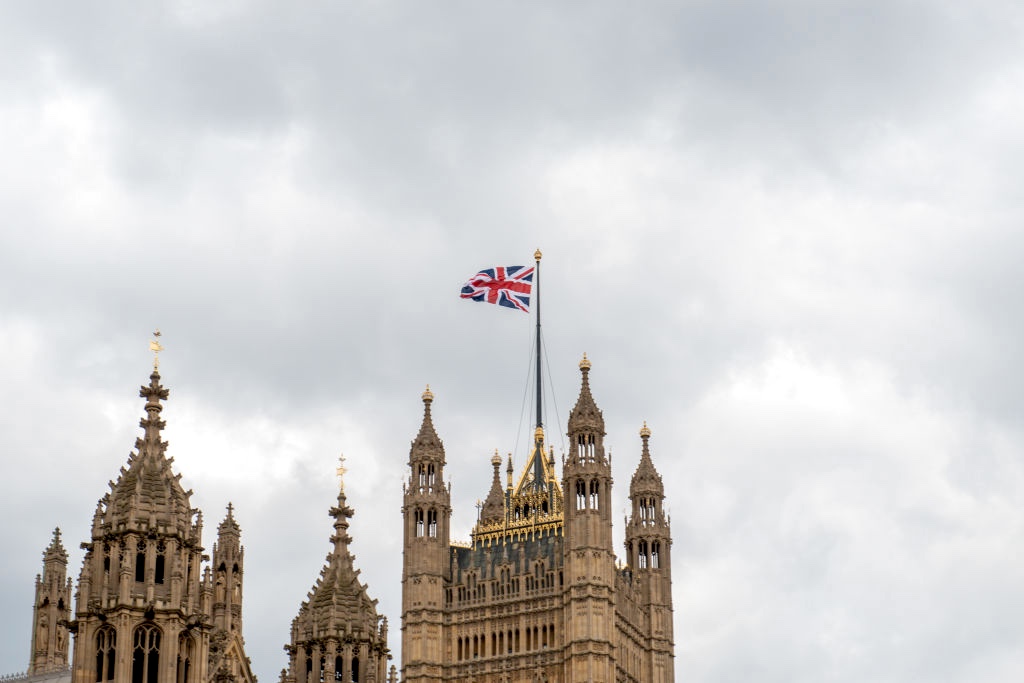
A British Union flag on top of the Houses of Parliament in London on June 7, 2024. (Zula Rabikowska / Bloomberg via Getty Images)
When I first arrived in the UK in 2009, a bank clerk asked me what I thought about London and the UK more generally. I clearly recollect to have replied “chaotic,” which prompted the bank clerk to correct my pronunciation and to laugh it off with, “It can’t be as chaotic as Italy!”
Fast-forward fifteen years, and I am waiting for yet another overcrowded, delayed, and truly chaotic train — the epitome of how British services run these days. Ironically, trains in mainland Europe, in places notorious for their inefficiency and cost, are not as disorganized. Don’t get me wrong, I am not suggesting that Southern Europe has suddenly solved all its issues of under-funding and inefficiency. Rather, I am hinting at how the national myth of British superiority over other European countries in respect to societal efficiency is severely detached from reality.
The idea that Great Britain is well organized was part of the reason why I moved here. It was touted as a core element of the meritocratic machine that made the UK attractive to cheap, highly skilled labor from mainland Europe in the 2000s. This sentiment of superiority was also prevalent during COVID, when the public opinion in the UK was initially very critical of the management of the pandemic in the “lazy South.” At one point, celebrity doctor Christian Jessen even suggested that Italian people might be using the pandemic as an excuse to have a “long siesta.”