Paul Mason, Please Stop It
British journalist Paul Mason has announced plans to run for election in Jeremy Corbyn’s constituency. It’s the culmination of Mason’s war with his former comrades — and it’s important that he is defeated.
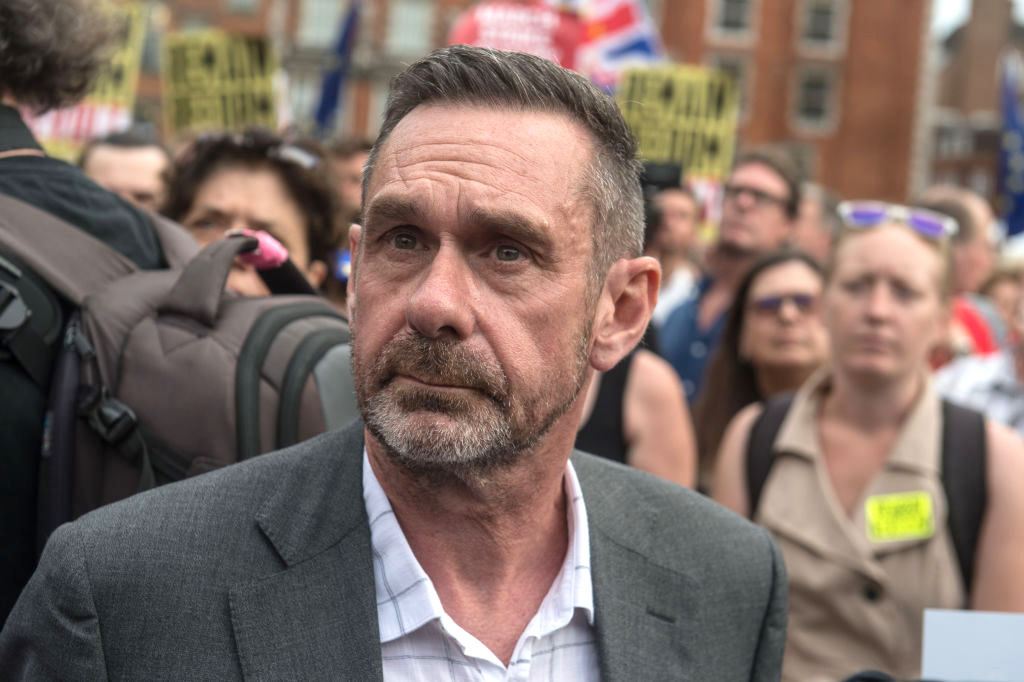
Paul Mason during a protest on August 28, 2019, in London, England. (Guy Smallman / Getty Images)
“If you don’t think [Keir Starmer] will advance the class struggle, you’re possibly not understanding social democracy correctly from a Marxist viewpoint.” Tweeting about Labour’s new leader on April 8, 2020, Paul Mason seemed optimistic about the Left’s prospects, despite its recent defeats. The former BBC journalist had begun this thread a mere twelve minutes after Bernie Sanders dropped out of the US presidential race, and four days since Sir Keir Starmer won the Labour leadership. For Mason, “the political revolution [Sanders] started will continue . . . *IF* the left stops expecting socialism to be achieved without class struggle — and *IF* we learn to build a broad alliance for democracy/rule of law like we did in 1930s.”
At face value, it sounded like Mason thought that the campaigns led by Sanders and Jeremy Corbyn were a good start but needed to be deeper and more radical. The author of Postcapitalism, who admirably chronicled the Greek revolt against austerity in the mid-2010s, often cast himself as a leading Corbyn supporter but expressed frustration at the “bureaucratic left” and its grip on the project. For Mason, it was missing the insights of the “anti-authoritarian left” and such ’68er thinkers as Antonio Negri, whose “anti-work” ideology could answer the needs of a “networked” postmodern society and more “horizontal” forms of organizing. In one New Statesman piece, he claimed that the “three Tonis” (Negri, Benn, Gramsci) needed to be combined in a radically democratic politics.
In Mason’s writings, it often sounded like the Corbyn project was doomed by the people who made it happen — Stop the War, the Unite union leadership, figures from the Communist tradition like Andrew Murray, even Corbyn himself. Old “anti-imperialists” and “economic nationalists” led the project along with the “effective but hierarchical unions” and the “networked anti-capitalism” of the youth. But tragically, these latter had been stifled; if only they, or their spokesman, had run the show. Mason wrote as the champion of grassroots “social movements,” even if this meant little more than small circles in the world of media and NGOs. Mason’s declared project, after Corbyn’s defeat, was to push for a realignment, a “million-member party” that could overcome Corbynism’s limits.