The FBI Agent and Informant Behind Fred Hampton’s Murder
Special Agent Roy Martin Mitchell was recognized within the FBI for his skill in developing informants in “the racial field.” Now we know the extent of Mitchell’s activities — including how they aided the killing of the Black Panther Party’s Fred Hampton.
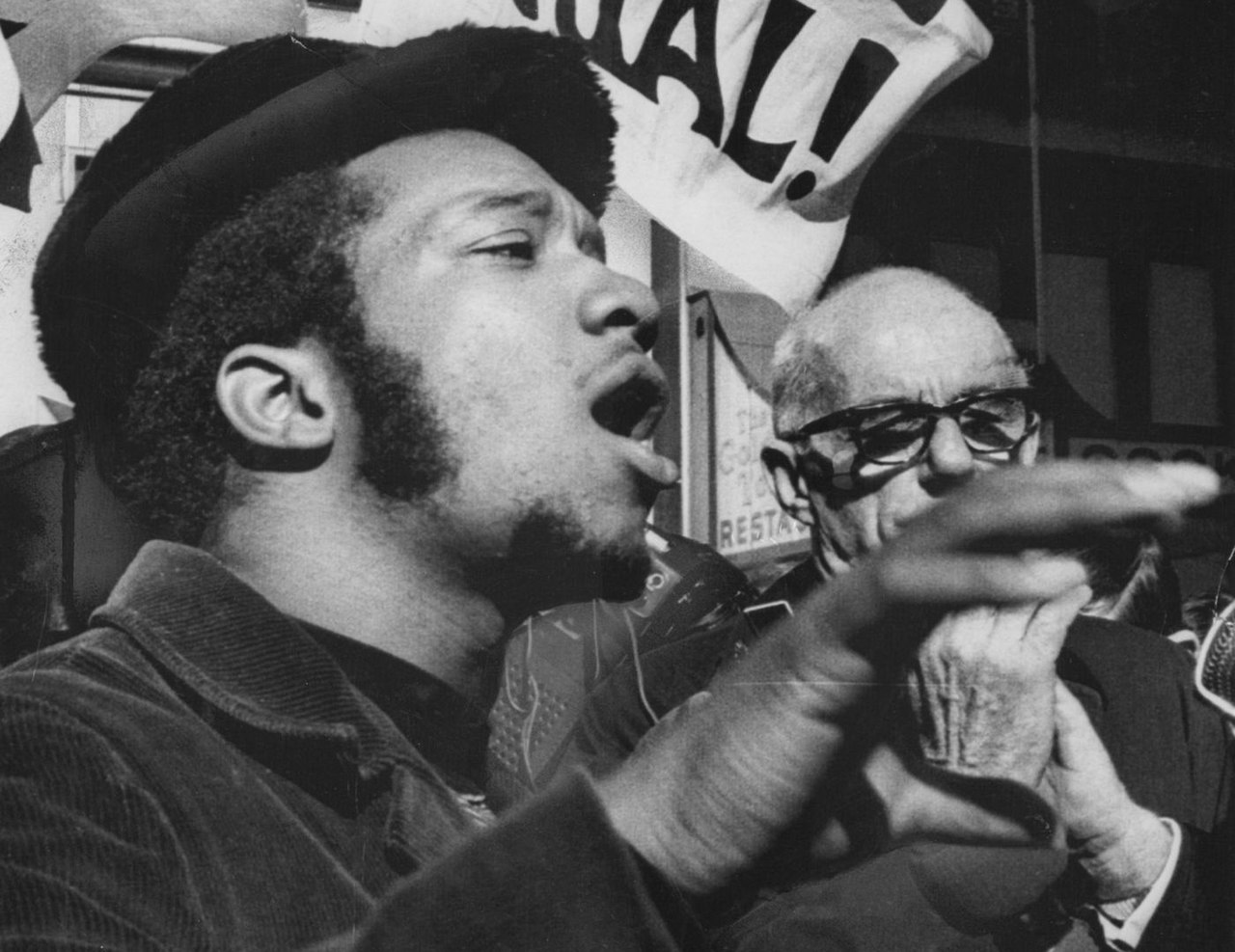
Fred Hampton and Benjamin Spock at a protest rally outside the Everett McKinley Dirksen U.S. Courthouse in Chicago, Illinois, October 1969. (AP Wirephoto / Chicago Tribune via Wikimedia Commons)
In the predawn hours of December 4, 1969, fourteen Chicago Police Department (CPD) officers, claiming they were searching for illegal weapons, raided a first-floor apartment on Chicago’s Monroe Street. Inside, nine members of the Illinois Black Panther Party (BPP) were in various phases of sleep. While police claimed they were fired on, the fusillade of over ninety bullets hit only Black Panthers. Two of them — Fred Hampton, the chairman of the Illinois Panthers, and Mark Clark, who had organized the group’s Peoria chapter — were fatally wounded.
Initially, the raid was seen as a success for the police, epitomized by the picture of grinning cops carrying Hampton’s body out of the apartment, which circulated widely in the press. However, the one-sided nature of the attack quickly gave rise to questions. In this, not only were the Chicago police under scrutiny, but questions arose about the role of the FBI, which had been keeping close tabs on the Chicago Panthers. What would later be discovered was that the bureau had a well-placed informant within the group. That informant had passed along a floor plan of the apartment to the CPD, by way of his FBI handler, to facilitate their raid.
To the degree most people today know the story of Fred Hampton, it is through the 2021 film Judas and the Black Messiah, a fictionalized account of the incident. The film, while dramatically riveting, is in important ways factually dubious. This is made clear in the movie’s opening when it has J. Edgar Hoover, portrayed by Martin Sheen, proclaiming the Black Panthers “the greatest single threat to our national security, more than the Chinese, even more than the Russians.” In reality, Hoover never said such a thing, nor would he, given how the bureau and the US government viewed China and the Soviet Union at that phase of the Cold War. Considering the power of such a statement, however, it is worth exploring how a variation of it found its way to becoming common knowledge.