The Legend and Legacy of the Young Patriots Organization
The Young Patriots were a group of radical poor white Southern migrants in Chicago who allied with the Black Panthers. Their use of the Confederate flag makes them an enduring object of fascination. A new book recounts the true story.
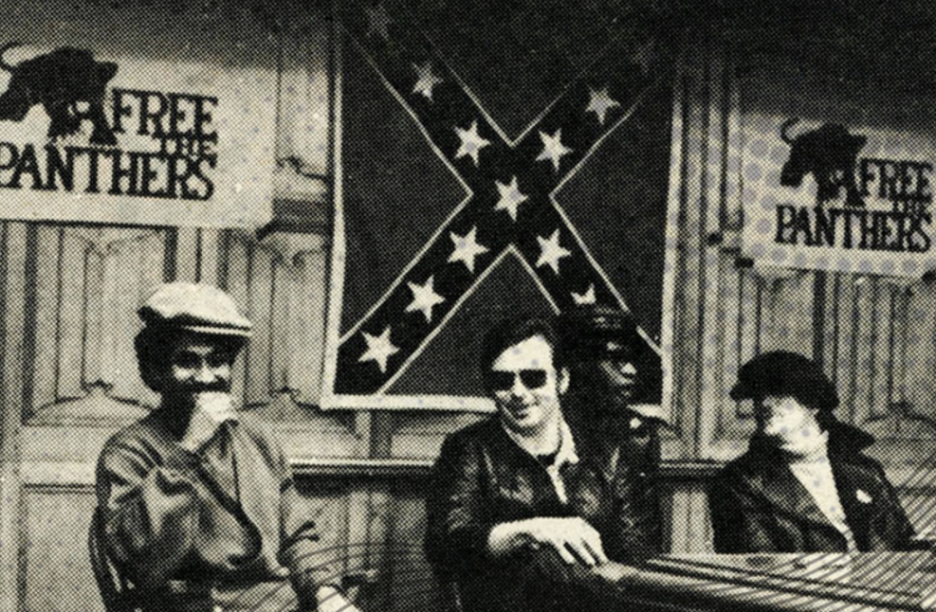
A joint appearance of the Black Panthers and the Young Patriots, late 1960s. (Jacobin Italia)
- Interview by
- David Griscom
In a room in Chicago in 1968, a surprising alliance was born. A Black Panthers leader named Bobby Lee addressed a gathering of poor white Southern migrants known as the Young Patriots, urging them to recognize their shared struggles. Uniting around the problems of police brutality, poverty, and worker exploitation, the Chicago Rainbow Coalition left an undeniable mark on the history of poor people’s struggles in Chicago and across the United States.
The story and images of the Young Patriots continue to shock and fascinate due to their decision to use the Confederate battle flag as a symbol of their anti-racist and anti-capitalist organization. Interest in the Young Patriots has been especially renewed in the wake of Donald Trump’s election in 2016, which has turbocharged discourse about the political challenges and potential of the white working class. Because many now discover the Young Patriots through isolated, context-free images posted online, the popular understanding of the Young Patriots is murky, as are many of the lessons people claim to have gleaned from the group.
Here to clarify the record is Jesse Montgomery’s deeply researched book, It Is Not Enough to Survive: The Young Patriots Story, which provides a corrective to the mythologized and imagined Young Patriots and sets them upright on their own two feet in the long march of working-class resistance. Jacobin’s David Griscom spoke to Montgomery about the real lessons of the Young Patriots, which are much more valuable than the fantasy.
David Griscom
What was the climate like in Chicago during the period of the Young Patriots, and where did these members come from?
Jesse Montgomery
The Patriots emerged out of the Uptown neighborhood in Chicago in the late 1960s. That neighborhood had become a kind of port of entry for all sorts of poor people, different migrant populations moving to Chicago for work. The largest group was white Southerners — folks who’d come from all over the South, especially the Mountain South, during the postwar period after jobs had disappeared in agriculture and mining.
So you have tens of thousands of white Southern migrants who are moving to this neighborhood, which is on the lake north of the Loop. Additionally, you have these remaining middle- and upper-class residents who recall the former heyday of the uptown neighborhoods, which in the 1920s were the first suburbs of Chicago. There’s already tension between these groups throughout the ’60s.
The new arrivals are trying to make a life in Chicago but don’t have any power to do that yet. And then, into this mix come a bunch of student organizers, especially members of Students for Democratic Society (SDS). They arrive in about 1964, and they begin to organize poor people in the neighborhood to build working-class power. That really amps up political conflict in the neighborhood and eventually leads to the formation of the Young Patriots.
David Griscom
What are those difficulties that people are facing? One of the things you talk about a lot in the book is the experience with the police. Where are these conflicts coming from?
Jesse Montgomery
The conflicts in Uptown emerge from the local middle- and upper-class residents attempting to restore the neighborhood to its former place by way of urban renewal: using the police in order to maintain some sense of control and authority and maybe push people out. The police and housing are two big issues.
Southerners who are coming to Uptown are coming for work. They want better jobs. There’s an expectation that work will be more available in the city and better compensated than it was in the South. When they arrive, they find that jobs in manufacturing and industry are not as plentiful as they had expected.
So you find a lot of people working for day-labor agencies, which are these super-predatory temp gigs. People line up in the morning, and they get sent out to some sort of cardboard-box-folding factory by the temp agency. The temp agency takes a cut of their paycheck and also signs an agreement stating that whoever they’ve sent to work at the factory can never be hired on any long-term basis.
So they’re experiencing predatory schemes in terms of labor. And the apartments that are plentiful are really run down and illegally subdivided. So they’re living in pretty grody, substandard conditions, too. And on top of it all, the cops in that neighborhood patrol a lot, and there are a lot of reports of physical assault.
One of the super interesting facets of the Young Patriots story is just how central police brutality was to the trajectory of organizing in that neighborhood. Throughout the 1960s, you have poor people in that neighborhood who, as soon as they are able to voice their concerns and name what they want to organize against, police brutality is really high on the list.
David Griscom
Let’s cut to the chase here. When most people see images of the Young Patriots today, they’re going to see something very peculiar, and I think it was even peculiar then. These figures are walking around with Confederate flag patches, and as you note in the book, right next to that is a “Free Huey” patch, referring to the imprisoned Black Panther leader Huey P. Newton.
Could you talk about the iconography of the Young Patriots and what they were trying to achieve there? It seems it was used as a shock factor to get people to wonder what this group is doing.
Jesse Montgomery
I think that you’re absolutely right that from the very beginning, the use of the Confederate flag was intended to shock, maybe even upset or unsettle people, and to open them up to some new ideas. There was never any sort of affection or attraction to the Confederacy as a political project, no veneration of Robert E. Lee, never even a kind of cheeky flirtation with any kind of Confederate or Southern secessionist rhetoric. The Confederate flag was used as a sectional symbol that was almost always provocatively displayed next to a Free Huey or Black Panther flag or patch.
Hy Thurman, one of the early members of the Young Patriots, has talked in interviews about the original logic and then the eventual retirement of the flag as a symbol. He says that they used it to force people, especially people in Uptown, into conversation. And over time, as their own political awareness grew, they came to understand its limitations.
There is a very interesting conversation to be had about limits of resignification and how far you can push it. But whether or not that was the best choice of symbol or the most effective, that was the rationale. It was an attempt to take one of the most hateful and nefarious political symbols in the country’s history and crack it open and produce a different politics.
And at the time, there were other Southern groups attempting to do something similar. The Southern Student Organizing Committee in the South used a logo of black-and-white hands shaking over the Confederate flag, and the Mississippi Freedom Democratic Party also used the Confederate flag with an oil lamp over it. So there were a handful of Southern radical groups attempting to leverage that symbol in order to make some kind of a new claim.

The Southern Student Organizing Committee (SSOC) had a logo of black and white hands shaking over the Confederate flag. (Hake’s Auctions) I think it’s important to note that they used that symbol because they thought it would generate productive intellectual friction in their own neighborhood. It was meant to be used in Uptown in Chicago. And so much of the Patriots’ political project was hyperlocal.
Finally, I would add that, as complex and contradictory as that theory seems, it’s also undeniable that those images still shock today to such a degree that the Patriots stick in the historical memory. And much of that comes down to that still perplexing symbolic wager.
David Griscom
In addition to the political work the Young Patriots were doing in their own community, they were building solidarity with other groups, including the Young Lords and the Black Panthers. Can you explain this relationship, who Fred Hampton was, and how he saw the Young Patriots Organization?
Jesse Montgomery
The Young Patriots formed in the summer of 1968. And they formed in Chicago around the same time as the Chicago Black Panthers. The Oakland Panthers formed in ’66, and the Black Panthers were becoming a real national force, but they didn’t yet exist in Chicago. So the Patriots and the Panthers emerged in Chicago around the same time.
The Patriots came out of an SDS organizing project in Uptown where community groups, after being organized by students, overthrew the students. They took control of their own group, and it was finally a radical organization by, of, and for poor people and working-class people. And that was one of the first points of connection between the Patriots and the Panthers.
They met sort of by chance at a church in Uptown in the fall of 1968. And before they met Hampton, they met this guy named Bob Lee or Bobby Lee, whose name is ironic. He’s actually named after Robert E. Lee —
David Griscom
And he’s a Texan, right?
Jesse Montgomery
He was a Texan, exactly, a black man from Houston’s Fifth Ward. He had gone to this church to speak about the Panthers program. And when he showed up, the Patriots were there, speaking about the problems they were facing in Uptown and their political program. Bob Lee listened and realized that they had the same struggle.
Bob Lee connected with them, and it was through that friendship and political partnership that they began to hash out an understanding of their shared condition. Lee would famously say that the Rainbow Coalition was just another code word for class struggle.
Lee then went to Fred Hampton and said that, as crazy as it sounded, he thought they should work with these poor white organizers in Uptown Chicago. Hampton was convinced by Lee, and that led to the establishment of the original Chicago Rainbow Coalition.
David Griscom
What was the Rainbow Coalition?
Jesse Montgomery
The original Rainbow Coalition, or Fred Hampton’s Rainbow Coalition, was a partnership between the Illinois Black Panther Party, the Young Patriots Organization, the Young Lords, and some smaller groups in Chicago. It was a local united front of these New Left revolutionary nationalist organizations, and it was announced on the first anniversary of the assassination of Martin Luther King Jr in Chicago.
You had these various groups standing shoulder to shoulder and saying, “We’re doing deep organizing in our neighborhoods, and we’re working across neighborhoods and lines of difference in order to fight the power in Chicago.” The brilliance of the coalition was this united front.
The Rainbow Coalition’s individual groups would support one another in protest activities or occupations. The Young Lords mounted a sit-in at a theological seminary that members of the Panthers and Patriots showed up for. It was a way to bring people together for actions but also to share organizing expertise. The Rainbow Coalition allowed people to see a political horizon that was bigger than their own group’s project and existed outside their particular neighborhoods.
David Griscom
These groups are being organized around racial lines. Could you talk about the relationship between this kind of project and the criticism of capitalism?
Jesse Montgomery
It’s an interesting moment where these groups were trying to articulate a politics that in some ways transcends nationalisms, transcended organizing in the interest of your own group, but without pretending that these distinctions don’t exist or don’t matter or aren’t political in some way.
Each of these groups sought to organize around class interests that were particular to their community as they defined it. For the Patriots, the ultimate horizon was always interracial solidarity within the working class. But they felt that the way to get there was to develop a political analysis that spoke to people’s lived reality, their sense of who they were and where they came from. They felt it was important to understand migrant Appalachian culture, and to ask, “What does white working-class Southern culture look like when it’s in Chicago?” They felt that the way that they could make an anti-racist politics of solidarity make sense to people in their neighborhood was by connecting on those levels.
Concrete organizing projects were designed to meet immediate needs, and different groups would participate in setting them up. So if you look at the health service the Young Patriots founded, they did so with the help of the Panthers, who were setting up another similar clinic. They shared ideas, they worked with organizations like the Medical Committee for Human Rights, and they publicly supported one another. They felt that this form of organizing, as long as it was at root based on class interests, could and would lead to solidarity. They were organized into distinct groups but at the same time committed to pushing past narrow definitions of collective self-interest.
David Griscom
What was the program of the Young Patriots? How did it relate to the Black Panthers?
Jesse Montgomery
The Rainbow Coalition was crucial to the Young Patriots’ program, but it wasn’t reducible to the Rainbow Coalition — and that was true of each member group. The primary work of the Patriots was survival programs, or serve-the-peopleprograms. They ran a free breakfast program and a free pantry like the Panthers did. One thing that was interesting about theirs in Uptown was that there was another free pantry run by a social service organization that was specifically designed to serve white Southerners — but was only available to white Southerners. So when the Patriots start their program, of course, there are no racial restrictions on who gets food and when they can eat.
They ran a couple of different educational programs. They had a Freedom School for several years. Doug Youngblood, who was one of the central Patriot organizers, also ran a poetry program. He published a magazine called Time of the Phoenix, where he would collect poetry from people in the neighborhood and run poetry workshops and then print and distribute this thing, which is a fascinating project.
Then there were the two biggest programs. One was the Young Patriots Health Service, or free clinic, an enormously popular and effective program they set up and ran for several years. At one point, it was staffed by ten volunteer doctors and dozens of volunteer nurses, filling a service gap in Uptown, where there was no health service accessible to poor people. They just started one with volunteer doctors and nurses, set up in a storefront. They got harassed by the Board of Health and the police, but it was so popular and in demand that it just kept growing. Eventually, it developed enough public support that even the newspapers were defending them against harassment.

Hillbilly kids in Uptown, Chicago, 1974. (National Archives) The other huge project they ran, or attempted to get off the ground over many years, was the Hank Williams Village — a cooperative housing development that was their response to urban renewal. For many years, they pushed to move this project forward in response to the city’s plans, and at various points it seemed on the verge of working before it was ultimately defeated. But that project was an attempt to meet the effort of the local middle and upper class to redevelop this slum section in the middle of Uptown and say: “You are trying to push us out and get rid of us. We recognize that this housing is indeed substandard. Here is our counterproposal.” The idea was a collectively managed, new-urbanist, green, radical hillbilly village that would have stood in the middle of Chicago.
David Griscom
Could you talk a little bit about the state repression that the Young Patriots faced? People likely know about the murder of Fred Hampton. What was it that the Young Patriots were up against from the local and even the federal government?
Jesse Montgomery
The Patriots were under surveillance for their entire existence. I’m sure no one reading this would be surprised to hear that. Even before the Patriots formed, when the student radicals were organizing in Chicago, they were under observation by the police from day one. From the outset, the Patriots were up against a coalition of the Daley machine, local elites, the police, and federal surveillance.
The Chicago Red Squad had them under observation and would occasionally send folks into the health clinic to try to get a prescription filled, using that experience to report back to the Board of Health and get them shut down. People werehauled in under suspicion of distributing medicine at various points. There were likely informants in their midst. They did not suffer the same level of physical repression that the Panthers did. But the closer that they got to the Panthers, the more intense the scrutiny was.
As the Patriots moved into running large-scale social programs, especially the health clinic, the city deployed an array of tools to slow those projects down on technicalities, fighting that battle effectively in courts and in the newspapers. Sometimes the repression was overt: police raiding an office, that kind of thing. But more often, authorities relied on quieter, bureaucratic obstruction to wear the organization down.
The most effective defense against that, however, was the Patriots’ ability to meet community needs in a way that was simply inarguable. By serving the people, they won genuine support from their community — and that proved as powerful a shield against repression as anything else they had.
David Griscom
Poetry and music are important to the Young Patriots. This is also a period when the right wing started to believe that claiming Southern culture, and country music in particular, might be politically beneficial to them. Could you talk about some of the ways the Young Patriots incorporated Southern culture into their movement in radical, revolutionary ways?
Jesse Montgomery
The Young Patriots felt that politics could produce a better life — and that art, culture, and collective self-expression were part of it. Things like the Poetry Project, things like the Freedom School, where they were attempting to understand where they came from, why they were in Chicago. That was part of the project for them.

A Young Patriots publication, 1970. (Washington Area Spark / Flickr) Their cultural politics — and this connects to our earlier conversation about the Confederate flag but also touches on country music — was rooted in a sense that culture had to be contested. Country music, to the extent that it contains left-wing or populist politics, only means something if you are actively arguing for it as such, if it’s recognized as such, if you can connect it to a political project in a meaningful way.
It can feel easy or satisfying to say that some work of popular culture, or some country music star, is actually left-wing or actually populist. The Patriots weren’t approaching culture that way. They were saying: country music expresses working-class sentiments, solidarities, and commitments. Let’s talk about those things. Let’s talk about how they make us feel, what histories they open up, and let’s argue for them. And then, let’s make music. Let’s write poetry. Let’s make our own stuff and use it to produce culture rather than just consume it or reframe it.
They attempted to radicalize white working-class culture in a specific context. They understood politics and organizing as part of the project of self-knowledge — through politics, they came to a better understanding of themselves, as individual activists but also as products of class history in America.
David Griscom
Readers will need to pick up your excellent book to get the full story, but could you talk a little about the decline of the Young Patriots?
Jesse Montgomery
The Young Patriots disbanded or drifted away in late 1972, early 1973. It’s difficult to pinpoint exactly when. There was no single dramatic defeat that fractured the group.
The defeat of the Hank Williams Village, and the expulsion of many white Southern migrants from Uptown as apartments were cleared and the neighborhood redeveloped, led to the group’s end. Part of what finished the Young Patriots was simply that their community was pushed out. As that community fractured, the group fell away with it. Individual organizers moved on — some had to leave; some left for work. It was not a dramatic end but a piece-by-piece fading. The death of Fred Hampton and the broader repression of the Panthers also contributed to the drifting of the Rainbow Coalition, removing the energy that had helped sustain it.
But another group of young radicals came into Uptown just as the Young Patriots were fading, and they were able — without direct contact with the Patriots — to carry that work forward fairly quickly. The insurgent working-class organizing energy the Patriots embodied wasn’t proprietary. It was picked up and carried forward, which is a testament to the Patriots’ ability to bring poor and working-class people into not just an organization but political subjecthood. They were a vibrant, creative, daring chapter in working-class organizing in Uptown — but just one chapter, and that work continued after them.
David Griscom
There is tremendous interest in the Young Patriots today, particularly after Trump won in 2016. Could you talk about some of the lessons from this moment of solidarity and why you think that interest exists?
Jesse Montgomery
The curiosity about the Patriots is fascinating. James Tracy and Amy Sonny’s book Hillbilly Nationalists, which came out during Occupy Wall Street, deserves real credit for the historical recovery work that brought the group to light. After Trump was elected, there was fascination from liberal mainstream media — people who looked at the Patriots and asked whether they explained Obama–Trump voters. That’s not the lesson to take from this group, even if the provocation is understandable.
A few things strike me as genuinely important. First, the Patriots are an example of a left-wing, radical, white working-class group with real social anchorage. They were embedded in a community they understood as their own, and their politics developed in place — not downloaded from SDS, not downloaded from the New Left; inspired by the Panthers but distinct from their politics as well. Those organizers felt responsible for the people they lived and organized with. That social anchorage was real, and it was sustained by discipline about which projects to take on and where to direct limited energy, because this was never a large group.
There’s also an important lesson in how the Patriots emerged from an SDS organizing project that came into poor neighborhoods to bring white working-class people into a widening civil rights movement — and how that student project was eventually, in effect, overthrown by the people they came to organize. That student effort was crucial; we don’t get the Young Patriots without it. But at a certain point, the model they brought in had to give way to something organic, something that actually empowered the poor and working-class people in the neighborhood, even if that meant the end of the original structure. Organizers have to be willing to let things go. Organizing yourself out of a job is a success, even when it’s painful.
And one last thing: this socialist, revolutionary, nationalist project that the Patriots were able to articulate started, for many of them, with an anti-police-brutality movement. They felt they were being targeted by police as Southerners in Chicago. That might seem like a narrow grievance, but it was an opening that led them toward a universalist politics. The path from whatever brings people into politics to where they might ultimately go is not always clear. But honoring people’s immediate experience — taking seriously what they tell you about how their lives could improve — is another lesson of the Patriots. Their deepest political commitments, whatever made it feel worth risking their lives and their security, started with experiences that felt real and touched their lives in urgent, dramatic ways.