The New York Times Has an Ugly Anti-Palestinian Bias
The fact that the New York Times assigned its investigation of October 7 sexual assault claims to Anat Schwartz, a non-journalist with anti-Palestinian beliefs and ties to the Israeli military, is an extreme reflection of the paper’s unflagging pro-Israel bias.
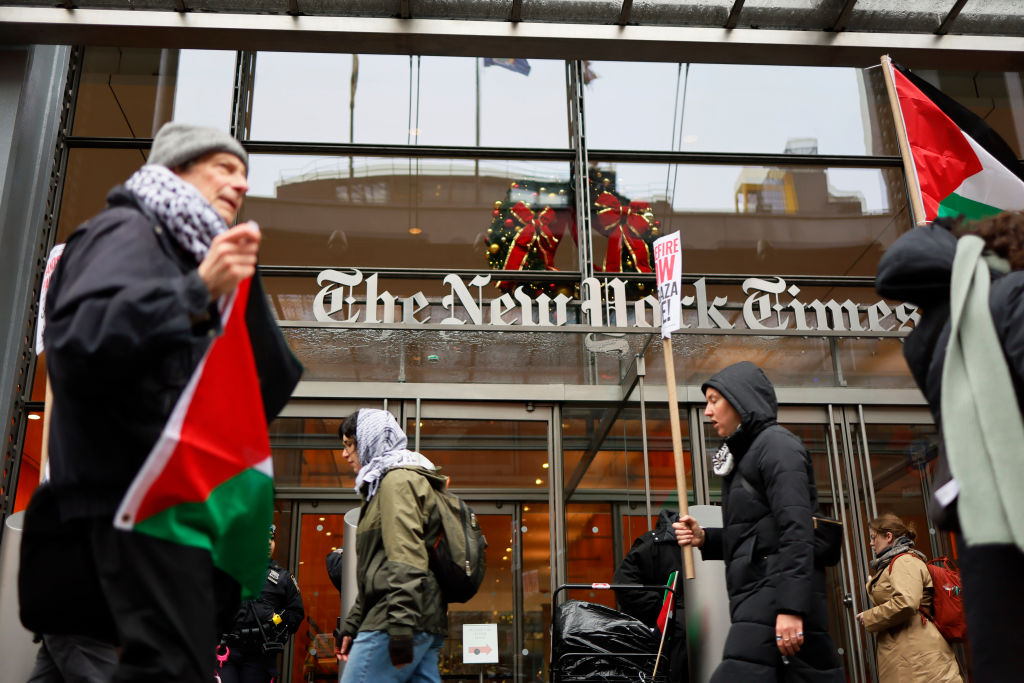
Pro-Palestinian protesters gather outside of the New York Times building to protest the newspaper’s coverage of Israel’s war on Gaza on December 11, 2023, in New York City. (Michael M. Santiago / Getty Images)
The New York Times may be the most prestigious daily newspaper in the English-speaking world. Its reporting has garnered 132 Pulitzer Prizes, starting with one the paper got in 1918 for its coverage of World War I. It racked up three more just last year.
At a time when it’s become increasingly common for news consumers to pride themselves not on reading or watching unbiased reporting but rather on frequenting sources on “both sides,” the Times can feel like a relic of a lost era, when the ideal of neutrality was still sacrosanct. The paper was historically nicknamed “The Gray Lady” for both its tradition of only printing in black-and-white — it didn’t start incorporating color images until the 1990s — and for a certain ethos of journalistic caution and stodginess.
As one of the reporters who collected a Pulitzer for the paper last year, Mona Chalabi, has pointed out, though, one of the areas where that reputation is hardest to square with reality is the Times’s coverage of Israel/Palestine. Just before Chalabi went to the Pulitzer ceremony in November, she posted a chart to her Instagram page that makes a devastating point.