How Rail Union Leader Mick Lynch Became a Working-Class Hero
Head of Britain’s RMT rail union Mick Lynch has in recent years become a household name. His stout defense of his members has won him wide acclaim — yet his newfound fame also reflects just how rare such voices are in British public life.
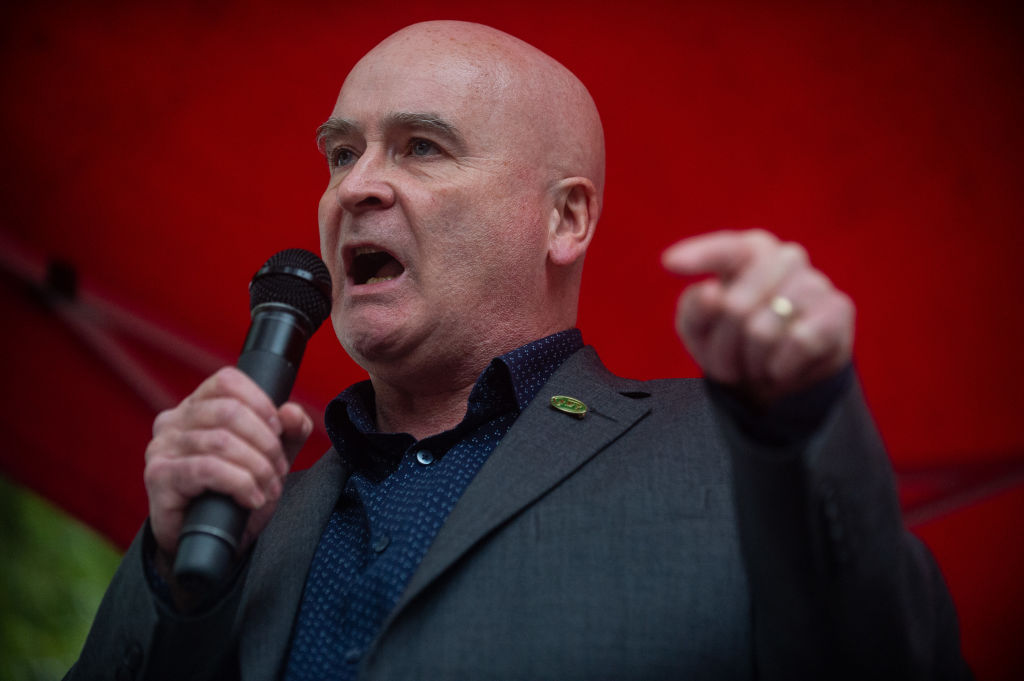
Mick Lynch of the RMT addresses a protest on August 31, 2023 in London, United Kingdom. (Guy Smallman / Getty Images)
In late June 2022, with the first national rail strikes of Britain’s “summer of solidarity,” a new standout national political figure emerged. This man was neither a left-wing Labour MP like Jeremy Corbyn nor a radical-left leader like George Galloway, but a trade unionist. Within just a few weeks, he went from being virtually unknown among the wider public to being instantly recognizable, all thanks to a handful of TV interviews. His demolition of established media operators — those supposed to have the professionally honed skills to take down their impertinent interviewees — was a joy for countless thousands to watch many times over. In what became known as the “hot strike summer” of 2022, this union leader became the man of the moment for all those angry and aggrieved at the Tories and the unequal economic and social status quo in “broken” Britain. For this first time in many decades, a strike wave brought widespread industrial action back to Britain — and Mick Lynch rode that wave.
Lynch is general secretary of the National Union of Rail, Maritime and Transport Workers (RMT): a union with under one hundred thousand members, and in this sense a minnow compared to the Unison and Unite unions, which are each over one million strong. But in defending RMT members’ right to strike in summer 2022, Lynch stunned pundits, simply by stating the basic principles of worker organizing. As he put it in one interview: “What else are we to do? Are we to plead? Are we to beg? We want to bargain for our futures. We want to negotiate. . . . I don’t want any working-class people in this country to have to beg their employers for a decent living.”
Though there were detractors in the right-wing press, many even in mainstream media showed no shyness in calling Lynch a “working-class hero.” On social media, Twitter/X and Facebook were awash with references to Lynch under this title. Within weeks of his first media appearances, “Mick Lynch working-class hero” mugs, tote bags, and T-shirts could be bought. Even the Financial Times, organ of the captains of capitalism in Britain, called Lynch “A new folk hero for Britain’s working class” and “a left-wing hero.” London’s Times chimed in, with Lynch termed no less than “a folk hero — a Robin Hood for the social media age.”