Industrial Policy Isn’t a Panacea for Rebuilding Organized Labor
Faced with China’s rise, Western states are turning from free trade dogmas to active industrial policies. This turn may offer opportunities for labor — but as the electric auto industry shows, it is also producing a harmful logic of national rivalries.
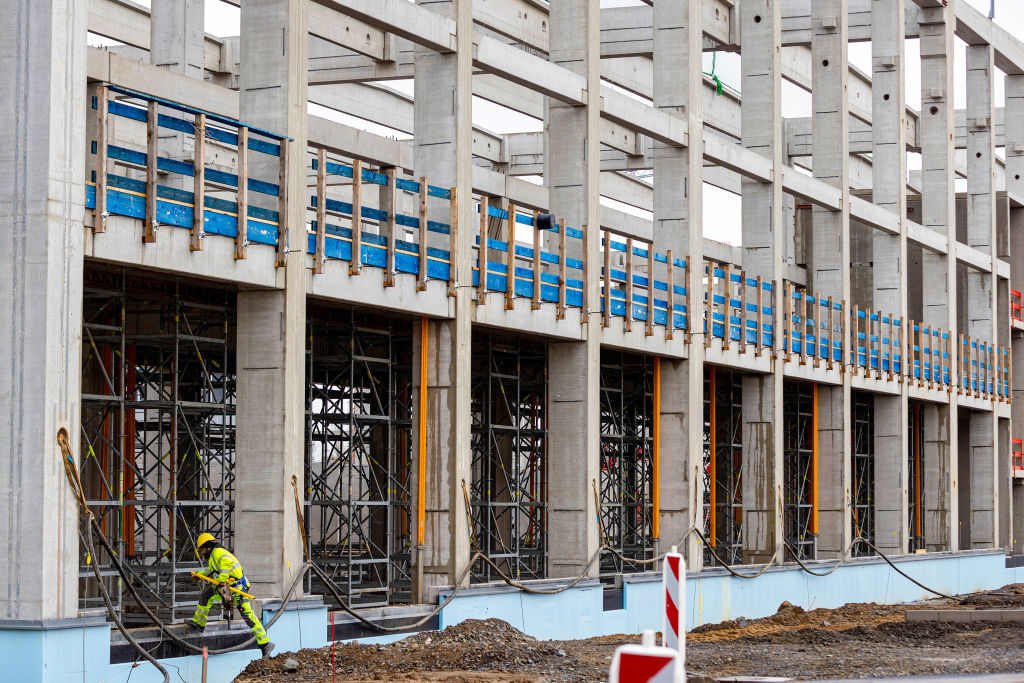
The construction site of the Volkswagen AG SalzGiga fuel cell gigafactory, operated by PowerCo, in Salzgitter, Germany, on November 21, 2023. (Krisztian Bocsi / Bloomberg via Getty Images)
Months before Joe Biden nominated him, National Security Advisor Jake Sullivan laid out his vision for containing Trumpism: he ditched the exhausted story of win-win globalization and proposed to beat Donald Trump on his own turf. This meant tapping into the MAGA narrative that linked the exhaustion of US global hegemony to the social dislocation manifest in the fallout of deindustrialization.
Under Trump and then Biden, the unemployed or underpaid industrial worker became the embodiment of an ailing, posthegemonic America. Fixing the condition of the American industrial worker meant restoring US leadership in the world, and vice versa: nothing captured this dynamic better than a sitting president showing up at a United Auto Workers (UAW) picket line in September.
This was a remarkable break with decades when the US state and its class of capitalists worked hand in glove to promote free-trade globalization by any means necessary. What changed? Simply put, globalization inadvertently enabled the Chinese economy to overtake the United States. Waking up to this reality, the US government decided that its own interests were more closely aligned with the average Joe who had lost his job to China than with Apple, Tesla, and the countless US firms whose profits relied on cheap Chinese labor and inputs.