Emily Wilson’s Iliad Gets Straight to the Point
A new translation of Homer’s Iliad attempts to combine the lyricism of the original Greek with direct and modern language. With a few exceptions, it hits both notes perfectly, making the epic poem feel dramatic and fresh.
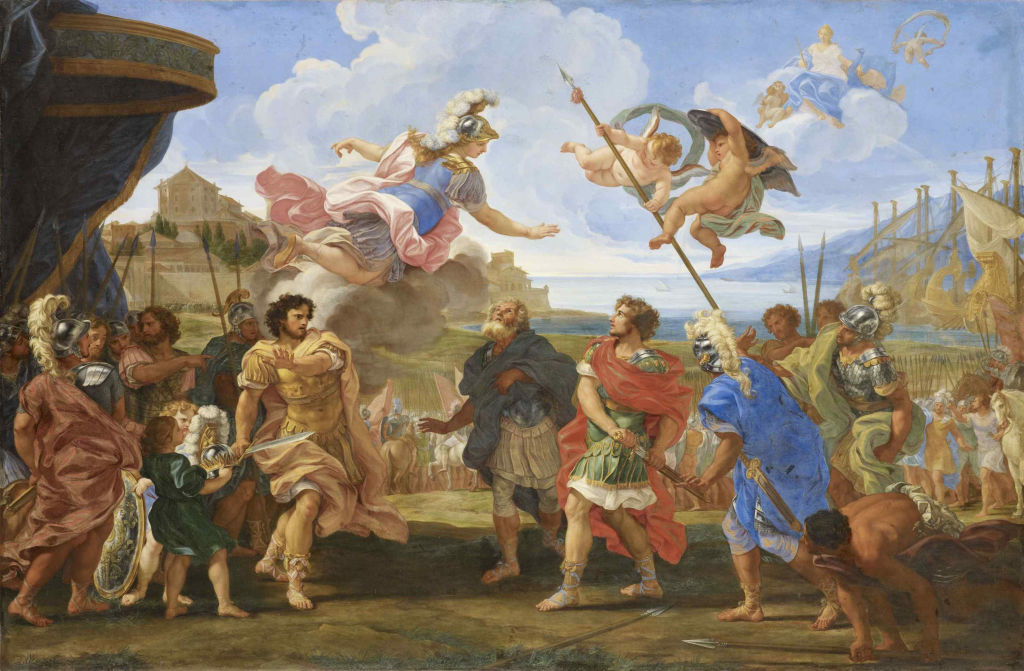
Agamemnon and Achilles quarrel in a 17th century painting by Giovanni Battista Gaulli. (Fine Art Images / Heritage Images via Getty Images)
In the small hours of an October morning in London, a young man made the walk from Clerkenwell to Southwark. His footsteps, his breath, his heartbeat all marked time as his mind wandered. He had been up all night, drinking with a friend. The two men read aloud from an old translation of Homer, shouting out in sheer delight. This was 1816 and it was the English romantic poet John Keats who, walking across the Thames, heard in his own heartbeat and footsteps the rhythms of George Chapman’s Homer “out loud and bold.”
Chapman was the first to translate Homer’s epics into English, complete and unabridged. His Iliad came out in 1611, the same year Shakespeare’s Tempest and Winter’s Tale made their stage debuts. Although Chapman would use iambic pentameter — five syllabic pairs, one stressed one unstressed — in his Odyssey a few years later, his Iliad is written in rhymed fourteeners — seven pairs of the same — the common measure of both prayer books and Philip Sidney. For about a century, Chapman reigned supreme as the greatest conduit to Homer for the English-speaking population, though the likes of Thomas Hobbes and John Dryden did put forward their own challenges. Then, between 1715 and 1720, Alexander Pope published his translation of the Iliad. Pope’s Homer was, until that October night, all Keats had known. Like his predecessors, Pope lopped off Chapman’s four extra syllables. Unlike Hobbes’s and Dryden’s, Pope’s translation all but put Chapman’s out of print.
If it weren’t for the names, the dates, the claret in London lodgings, this could be a modern story. The pace at which translations have gone in and out of favor has only sped up. Over the past decade, we’ve been moving at a rate of one new Iliad every two years; Emily Wilson’s is the most recent. We’ve seen Homer dressed in the writing styles fashionable during every literary period, watched as the poems shed their rhymes, meter, even line breaks. Scores of expensively educated men (and they were all men, until Caroline Alexander joined their ranks in 2015) lined up to take their shot at the literary and commercial success of Pope’s translation. Many criticized. Few surpassed. Of the critics, the Victorian academic and poet Matthew Arnold is the most canonical. Homeric verse, Arnold argued in an 1860 series of Oxford lectures, had four key qualities: it is rapid, noble, and plain and direct in both syntax and thought.