Mass Protests in Panama Have Come Close to Holding the Mining Sector to Account
A wave of mass protests in Panama, organized by environmentalists, indigenous activists, and trade unions, has forced the government to hold a referendum on the contract of Canadian-owned First Quantum Minerals, the country’s largest mining company.
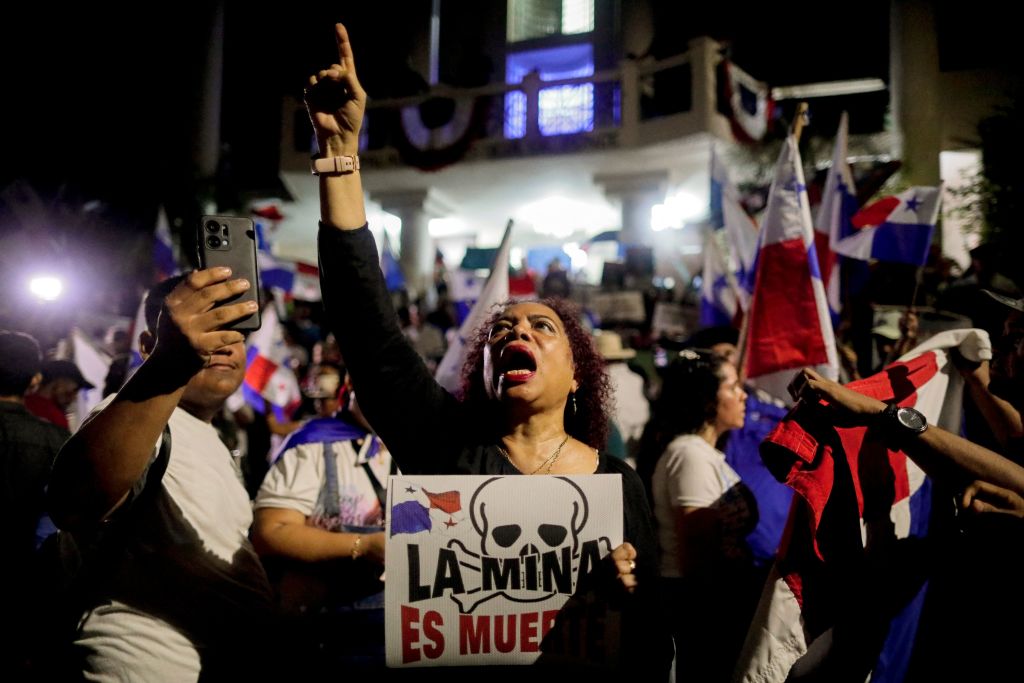
Protesters take part in a demonstration against a government contract with Canadian mining company First Quantum Minerals in Panama City, Panama, on November 24, 2023. (Roberto Cisneros / AFP via Getty Images)
For over a month, protests against First Quantum Minerals, a Canadian mining company, have gripped Panama. The Vancouver-based First Quantum owns the country’s largest copper mine, Cobre Panama, through a subsidiary named Minera Panama. The generous terms of the company’s mining concessions, both in Panama and elsewhere, have seen it rise to become one of Canada’s largest miners.
Cobre Panama is an open-pit copper mine located in the Donso district of Colon Province, an area of bountiful biodiversity. It is the largest single private investment in Panamanian history. The mine comprises 5 percent of the country’s GDP and 75 percent of its export earnings. These facts, regularly publicized by First Quantum as evidence of the company’s importance to Panama’s economy, raise two important questions: If the mine generates so much wealth, why is it that Panamanians themselves see so little of the profits? And, is the generation of that supposed wealth worth the environmental risks?
First Quantum inherited the mine’s contract from another Canadian company, Petaquilla Gold, in 2013. Petaquilla had signed a contract with the Panamanian government in 1997, which the country’s supreme court ruled to be unconstitutional after Panama’s Environmental Advocacy Center (CIAM) filed a lawsuit against it. The lawsuit argued that “the concession was given without public bidding, without consultation with the communities and without a true environmental impact study.”
Initially, Quantum resisted the ruling, but the court upheld the decision in 2021. As a result, the government forced the company to enter new negotiations, which progressed badly. At one point, the Panamanian government unilaterally halted production at Cobre Panama. The Justin Trudeau government responded by dispatching officials to vouch for First Quantum with the Panamanian government.
On October 20, the company and government came to a new agreement, the terms of which remain highly generous to First Quantum. The contract not only gives First Quantum the right to continue its open-pit operation for at least another twenty years. “Among its provisions,” writes Andrea Salcedo, “it allows First Quantum to make offers on land it deems necessary for its operations. If the owner declines the offer, the contract states, the company can ask the government to seize it on its behalf.” Given Central America’s violent history of land dispossession, especially related to mining, this is an extremely worrying provision.
Since the passing of the new contract, Panamanian society has erupted in protest. In the Globe and Mail, Niall McGee writes: “The contract was denounced by environmentalists, Indigenous groups, labour activists and religious groups, who opposed it both because of its financial terms and because of the impact the open-pit mine has on the environment.”
Protesters are blocking roads and ports, and disrupting major infrastructure. First Quantum, which denounced the protesters’ methods as “illegal and violent,” has seen its market value plummet by 40 percent. Meanwhile the Panamanian government claims the popular mobilizations are costing the state $80 million per day. This public pressure led President Laurentino Cortizo to halt new mining approvals and announce a public referendum on whether or not the contract with First Quantum should be repealed. The vote will be held on December 17.
Ordinary Panamanians, who are dealing with high inflation and unemployment, are sick of being excluded from decisions concerning their country’s extractive industry. They are also alarmed by the environmental risks, which include the contamination of drinking water and the deforestation of land on the mine’s thirty-two-thousand-acre plot. A rallying cry of the protests, “Panama is worth more without mining,” calls to mind the example of El Salvador, which banned metals mining outright in 2017.
Of course, the public has known about these dangers for a long time. In April 2022, the Panama Worth More Without Mining movement released a report that found over two hundred “serious” breaches of environmental commitments by the project managers, including “the felling of 876 hectares . . . in an area of high biodiversity and international importance,” inaction on the promised reforestation of 1,300 hectares, and “the discharge of waste from the tailings tank into natural bodies of water without official endorsement.”
Environmentalists are, however, not the only people opposed to the mining contract. Trade unions, students, and much of the broader public, fed up with the negotiations’ lack of transparency, have also stood up against the company.
The protests have turned deadly. On November 7, an enraged driver shot two protesters at a roadblock; police have also used repressive measures against the resistance. On November 16, fishermen tried to block the entry of a ship into the Punta Rincon International Port, owned by First Quantum. The National Aeronaval Service (SENAN) chased them away amid clouds of tear gas and pellet ammunition, causing numerous injuries.
Opposition to the Cobre Panama project is not new. When Panama began negotiating its free-trade agreement with Canada in 2010, MiningWatch cited the project as an example of the “existing threats to Indigenous peoples and the environment.”
In 2011–12, for instance, the country rose up demanding the annulment of mining and hydroelectric concessions on indigenous territory. Then president Ricardo Martinelli dispatched the riot police, killing one protester, injuring thirty-two, and detaining forty. Protesters responded by blockading the entrances to the Cobre Panama mine and another mine owned by Petaquilla. Ultimately, the social mobilization was so powerful that Martinelli agreed not to sanction mining projects on or near Ngäbe-Buglé territory.
Ten years later, in the summer of 2022, nationwide protests swept the Central American country, with diverse social groups calling for the Cortizo government to guarantee the economic security of the population in the face of rising food and fuel prices. The protesters represented a broad coalition of sectors: teachers, students, trade unionists, farmers, indigenous organizations, and anti-mining activists. Amid state repression, their program quickly widened beyond the inflation crisis to include the government’s inaction on poverty, unemployment, housing, corruption, indigenous rights, and more. The current opposition to First Quantum must be viewed as a continuation of these progressive protest movements.
The Canadian government has been silent on the uprising in Panama, but its attitude toward the protests can be surmised. When Cortizo halted production at Cobre Panama last year, the Trudeau government acted to ensure production continued, with Canada’s trade minister Mary Ng liaising between First Quantum and Panama’s commerce and industries minister Federico Alfaro.
Moreover, readers may know that Canadian mining companies are prominent investors in Central America and Latin America generally, their mines often serving as flashpoints of environmental, economic, and social unrest. In response to such conflagrations, the Canadian government always provides diplomatic and material support to governments that repress the protests and keep the extractive machinery moving, as evidenced by Ottawa’s unconditional backing of the Peruvian government’s massacring of indigenous-led protests last year, which claimed the lives of forty-nine.
Fealty to the Latin American mining sector explains a great deal of Ottawa’s foreign policy. It explains why Canada supported Ecuador’s corrupt and discredited former president Guillermo Lasso, as well as why it launched a legal assault on AMLO’s overhaul of the Mexican mining industry, which sought to grant the state greater control of Mexico’s natural resources.
However, broader geopolitical considerations also provide context for Canada’s response to events in Panama. Ottawa’s Critical Minerals Strategy, for instance, is a major policy through which it aims to “delink” its tech inputs from China as part of the new Cold War. Copper, the metal produced at Cobre Panama and one of the minerals identified as “critical” by the Canadian government, is a key input required to produce electrical vehicles (EVs). China currently leads the way in producing EVs, but greater control over the crucial mineral would make Canada less dependent on the People’s Republic.
The hope of Canadian and Panamanian elites is that both parties can advance their aims without having to respond to the democratic challenges to either Cold War saber-rattling or environmental degradation.
We don’t yet know how the December 17 referendum will unfold, but we know this: the Panama uprising is a direct challenge not only to First Quantum, but to Canadian mining policy in general, as well as Canada’s unearned image as a global champion of environmentalism, democracy, and human rights.