A Newly Translated Novel Captures the Tragedy of Greek Communism
Written in 1972, during Greece’s military junta, leftist Marios Chakkas’s recently translated novel The Commune is a mournful testament from a world where the stakes of politics were communism or fascism, democracy or dictatorship.
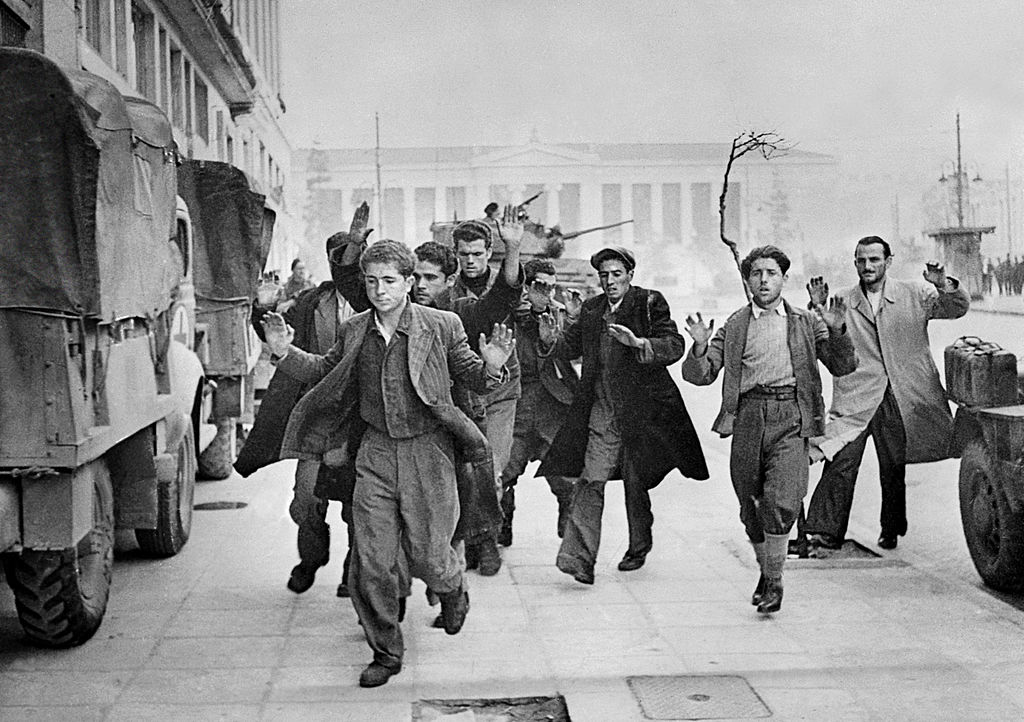
Almost 50,000 communist partisans were imprisoned after British troops entered Athens in 1944. (AFP via Getty Images)
Greece’s communists began the mid-twentieth century on the battlefield, moved from there to the prisons and then, if they were lucky, exile. The less fortunate found themselves in front of firing squads.
During World War II, the Communist Party of Greece (KKE) led the resistance against the Nazis, and at the end of the war, it controlled most of the country. Yet when the British-backed government in exile returned, it launched an anti-communist purge, imprisoning almost fifty thousand partisans and empowering right-wing death squads to act as police.
By 1946, when the communists revolted against this White Terror, the Cold War had begun. They thus found themselves facing not just the king’s government, but also the United Kingdom and the United States, in the West’s first test of the Truman Doctrine. After the communists’ defeat in 1949, the government passed Emergency Law 509, outlawing the KKE. Then, on April 21, 1967 — after two long decades of anti-communist collaboration between the CIA and the Greek state — a group of far-right military officers staged the coup that installed the Regime of the Colonels, which would exile the last fragments of the Greek left to remote islands in the Aegean.