Read Vivian Gornick’s Romance of American Communism
Based on interviews with former Communist Party members, Vivian Gornick’s The Romance of American Communism is a book full of emotional people who struggle to talk about their emotions. It shows how Party commitment gave everyday life an epic dimension — and made political defeats into personal traumas.
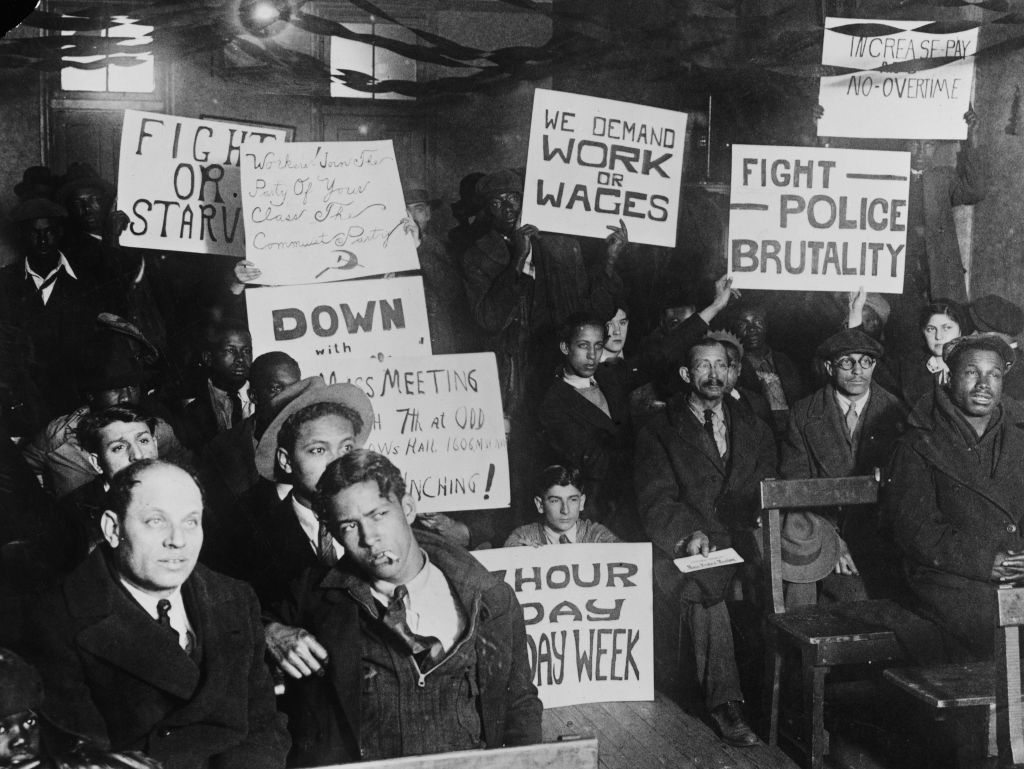
A group of men gather at a headquarters of the Communist Party USA following a protest demanding pay raise and an end to police brutality, US, circa 1920.Hirz / Archive Photos / Getty
In the late 1960s and early 1970s, journalist and critic Vivian Gornick published several long, impassioned articles in the Village Voice about her experiences in and impressions of the burgeoning women’s liberation movement. Reflecting on that period of feminist revelation and agitation in 2015, she described a disavowed conflict “between the ardor of our revolutionary rhetoric and the dictates of flesh-and-blood reality . . . nearly every one of us became a walking embodiment of the gap between theory and practice.” This same theme inspired her 1977 work The Romance of American Communism, which comprises interviews conducted in the mid-1970s with former members of the Communist Party USA (CPUSA). In her new introduction to Verso’s reissue of the book (out this month), Gornick recalls that witnessing the emergence of dogmatic behavior at feminist meetings prompted her to revisit the Communist milieu of her childhood. In so doing, she sought to examine the contradictory ways people lived their political commitments within the constraints of the Party.
Gornick’s account begins by reflecting on memories of the Party members and fellow-travelers encountered at her family’s kitchen table in the Bronx: “They spoke and thought within a context that had world-making properties.” Beginning with a discussion of immigrant Jewish communities in New York, she then travels across the United States, emphasizing the varied backgrounds and life trajectories of Party members — “in the fields of California, in the auto plants of Flint, in the steel mills of Pittsburgh, in the mines of West Virginia, in the electrical plants of Schenectady.” Some of those she speaks to were expelled from the Party, some were tried by the House Un-American Activities Committee during the McCarthy era, some went underground when the threat of fascism seemed imminent. Others left of their own accord — many in the aftermath of Nikita Khrushchev’s “Secret Speech” to the Soviet Communist Party’s Twentieth Congress in 1956, though some clung on until the Warsaw Pact invasion of Czechoslovakia in 1968.
The Romance of American Comminism explores political engagement through the lens of “impulse, need, fear, doubt, and longing” — and Gornick’s prose drips with emotion. When the book was first published, it was not rapturously received by those on either the Left or the Right. In a review in the New York Review of Books, which Gornick claims sent her “to bed for a week,” Irving Howe pulled no punches: