The Immortality Hustle
Silicon Valley’s quest to achieve eternal life is pure quackery. But it reveals much about the antidemocratic pathologies of the global superrich.
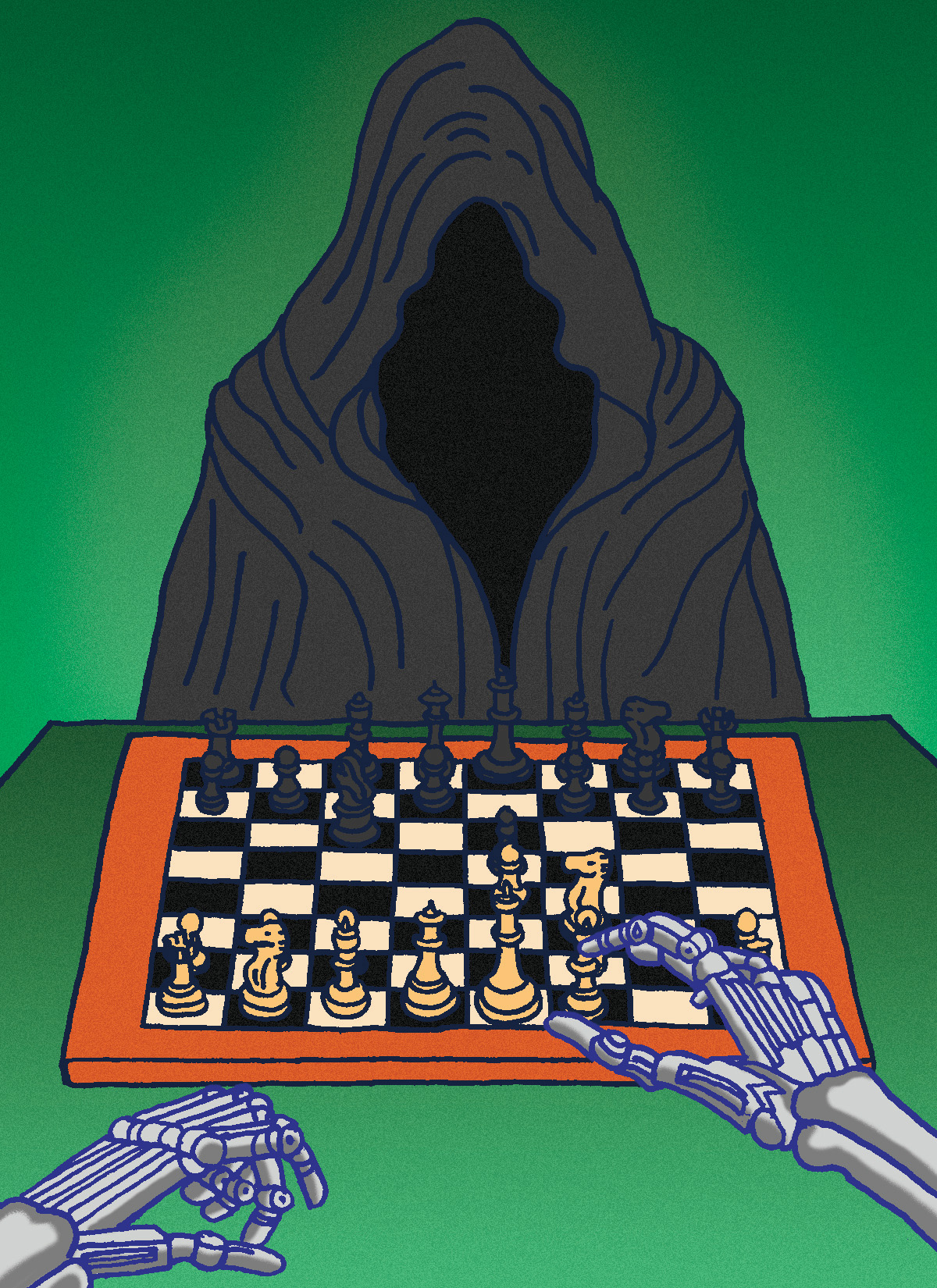
Illustration by Gaurab Thakali
In 2017, writer and media theorist Douglas Rushkoff received an unusual invitation to speak at a luxury resort. Offered a generous commission and a vague but innocuous-sounding prompt — “the future of technology” — Rushkoff arrived at the appointed time expecting to find a Davos-esque gathering of a few hundred investment bankers ready to pick his brain about predictable subjects like 3D printing or the blockchain. Instead, the author was ushered into a space so small and unassuming he initially mistook it for a green room.
As it turned out, no audience of expectant financiers awaited him, just a small roundtable and five exorbitantly wealthy men drawn from the most elite niches of the hedge fund world, whose questions quickly took on a strangely sinister air.
In place of the techno-optimism that so often characterizes the public-facing rhetoric of the superrich, this coterie of plutocrats had a much grimmer and more dystopian set of concerns. Channeling Elon Musk’s fantasies of interstellar colonization, Peter Thiel’s quest to reverse the aging process, and the reveries of transhumanists who one day hope to upload themselves to computers, all were less interested in wielding technology to solve collective problems than in using it to escape them. They were, in Rushkoff’s words, “preparing for a digital future that had a whole lot less to do with making the world a better place than . . . transcending the human condition altogether and insulating themselves from [the] very real and present danger of climate change, rising sea levels, mass migrations, global pandemics, nativist panic, and resource depletion.”