With Kevin McCarthy’s Removal, a Long Government Shutdown Just Got More Likely
Kevin McCarthy’s ouster as House speaker shows just how hopelessly divided the Republican Party is. But divided doesn’t mean harmless — the hard right can still inflict pointless suffering on the millions of people who depend on government services.
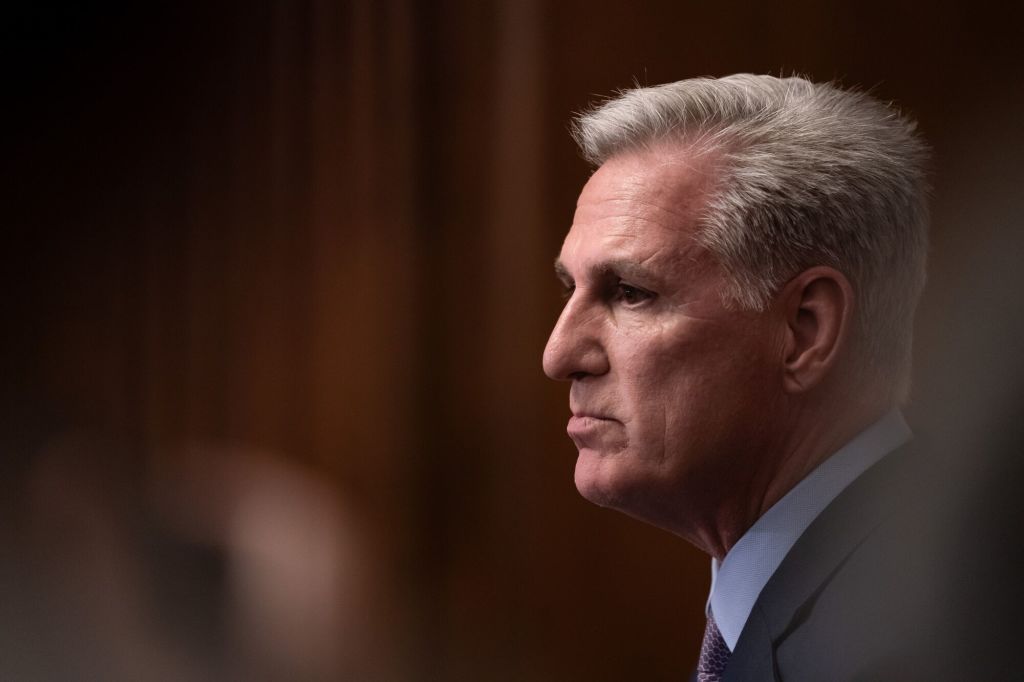
Representative Kevin McCarthy of California at the US Capitol in Washington, DC, October 3, 2023. (Nathan Howard / Bloomberg via Getty Images)
In the Sermon on the Mount, Jesus proclaimed, “Blessed are the peacemakers.” That message has not yet reached the House Republican caucus. After less than a year of attempting to maintain a ceasefire among members of his party, Kevin McCarthy was ousted yesterday as Speaker of the House by a handful of Republicans. His downfall serves as a reminder of how deeply divided the GOP remains, and a warning of the high risks and low rewards that await those attempting to bridge that chasm.
McCarthy’s tenure as speaker, the shortest in a century and a half, began with portents of its inglorious end. With only a single-digit majority coming out of the 2022 midterms, McCarthy was forced to hamstring his own speakership from the beginning. A number of far-right Republicans, led by deeply media-conscious figures like Colorado representative Lauren Boebert and Florida representative Matt Gaetz, insisted that McCarthy accept rules designed to weaken his position as speaker: most centrally, a provision allowing any House member, at any time, to call a vote to remove the speaker. After fifteen rounds of balloting that paralyzed the House for the better part of a week, McCarthy finally assented.
From the beginning, then, McCarthy’s speakership was defined by his futile attempts to mediate between the party’s right-wing and ultraright-wing factions. In this, he followed in the footsteps of his predecessors. John Boehner, who led the Republicans in the House as speaker from 2011 to 2015, retired from the position amid persistent challenges to his leadership from the House Freedom Caucus, formed out of Tea Party congressmembers after the 2010 midterms. His successor, the Tea Party darling Paul Ryan, announced he was retiring after serving just two and a half years as speaker, during which time he was unable to rouse Donald Trump’s interest in any part of his legislative agenda beyond tax cuts for the rich. Trump’s followers, meanwhile, detested Ryan, and plotted his removal.