How Stanley Kubrick’s Spartacus Broke the Hollywood Blacklists
Telling the story of a slave revolt in ancient Rome, the 1960 film Spartacus was penned by two blacklisted Communist writers. Its arrival in theaters was a middle finger to the McCarthyist witch hunt in Hollywood and publishing.
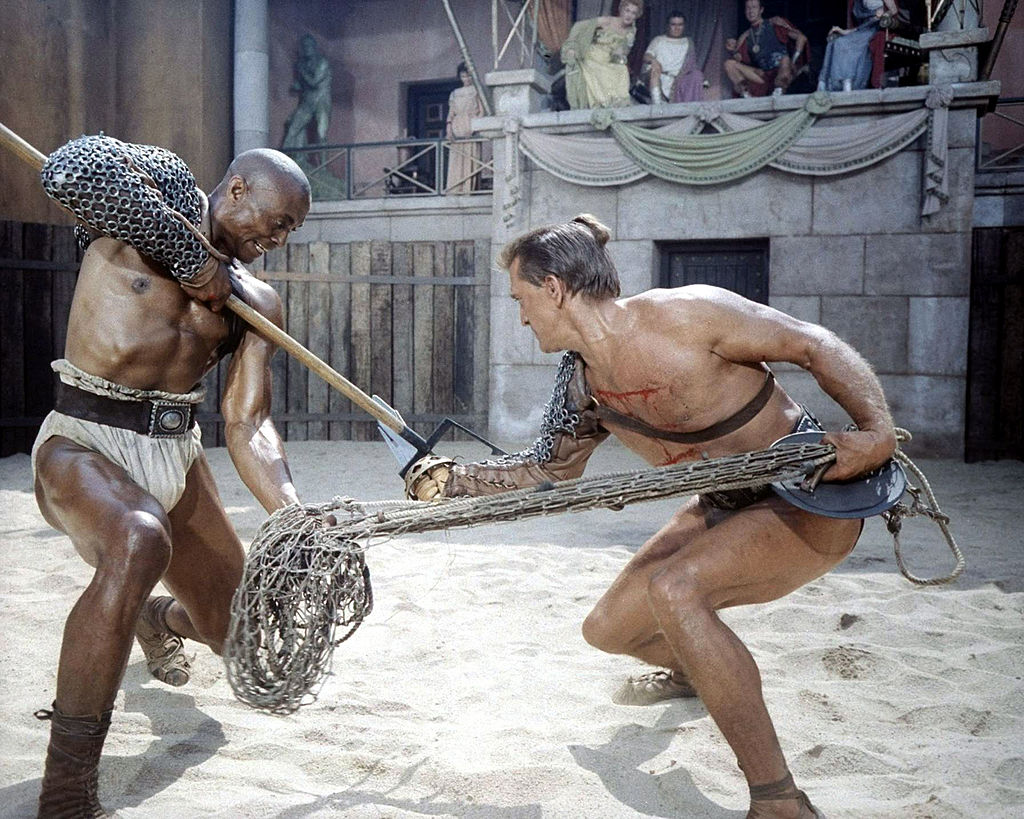
Woody Strode (L) and Kirk Douglas (R) in gladiatorial battle in a publicity still issued for the 1960 film Spartacus. (Silver Screen Collection / Getty Images)
May 1, 1946 was an unparalleled May Day for the Left in America. Recently discharged veterans joined with teachers, writers, artists, lawyers, and other workers to march triumphantly through Manhattan. “The number of paraders, as we counted them, was over 150,000, and when they packed Union Square, cheering left-wing and Communist leaders and speakers,” the Communist writer Howard Fast wrote in his memoir, Being Red, “one would have said that the future of the left in America was extremely bright and of course they would have been wrong.”
By May Day of 1948, the same Communists who were celebrated only two years earlier became the targets of violent reactionary crowds chanting “Kill a commie for Christ!” Fast was leading the Communist Party’s “culture block” made up of thousands of academics, artists, and writers who quickly found themselves in a street fight with anti-communist students from a nearby parochial school.
The second parade was a bad omen. With the advent of the Second Red Scare and Cold War, Communists soon became the national enemy, seen not as freedom-fighting progressives, as they had been by many on the broad left, but instead as anti-American authoritarians and dangerous subversives. Fast himself was called before the House Un-American Activities Committee (HUAC) and was imprisoned when he refused to name names.