James Joyce Was a Product of Ireland’s Revolutionary Generation
Cold War liberals presented James Joyce as a universal writer and ignored the clear political undercurrents running through his work. A new generation of critics have restored the vital link between his novels and Ireland’s uncompleted revolution.
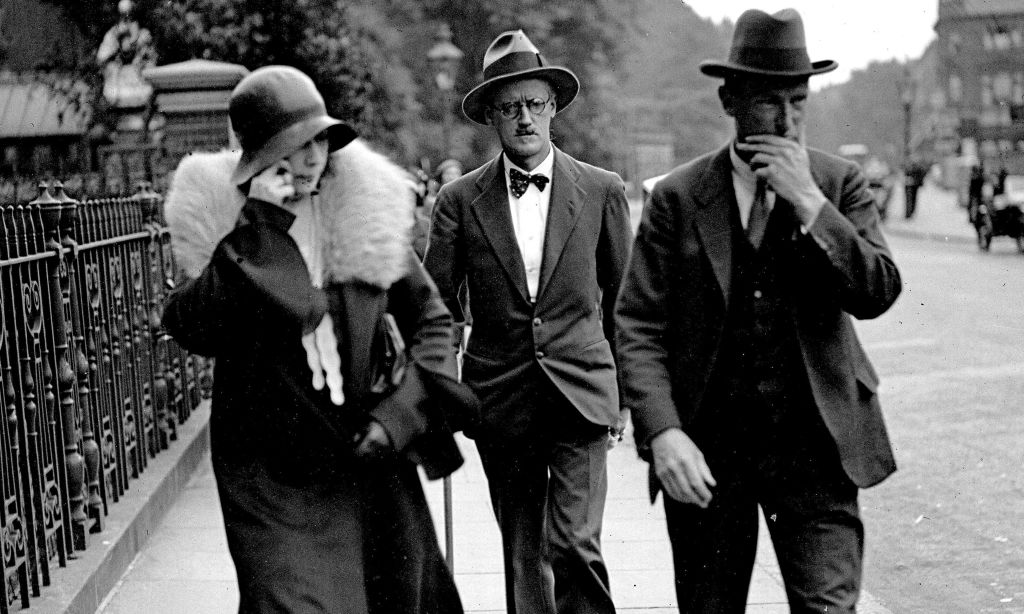
James Joyce, Nora Barnacle, and their solicitor in London on July 4, 1931, the day of their marriage. (Fine Art Images / Heritage Images / Getty Images)
James Joyce was a member of Ireland’s revolutionary generation. The author of Ulysses (1922) was born in 1882, the same year as Éamon de Valera, and three years after Patrick Pearse in 1879. The latter two figures proved to be instrumental in realizing a political revolution in Ireland between the years 1916 and 1923 that would see it gain effective national autonomy.
Joyce, on the other hand, would bring about a cultural revolution that was equally significant for Ireland, but was never registered as such by his domestic contemporaries. This was true not least of those who led and participated in the political revolution, many of whom were strongly averse to a famously “indecent” book authored by a divisive Irish émigré living in Paris.
One of Ireland’s most profound if idiosyncratic cultural critics, Luke Gibbons, seeks to bring these two revolutions into the same framework in his important new work, James Joyce and the Irish Revolution: The Easter Rising as Modern Event. Through a series of engrossing vignettes drawn from a wide array of contemporary sources, he positions Joyce’s “revolution of the word” under the light emitted by the 1916 Easter Rising and sets out to “reclaim what was radical in the Irish revolution for a modernist project akin to that of Joyce’s.”