Elmer Benson Showed What a Left Willing to Wield Power Can Do
Elmer Benson became the governor of Minnesota in 1937. His two-year tenure, during which he called the National Guard to defend strikers while other states had police crush them, is proof of the power that a Left capable of controlling the executive can exercise.
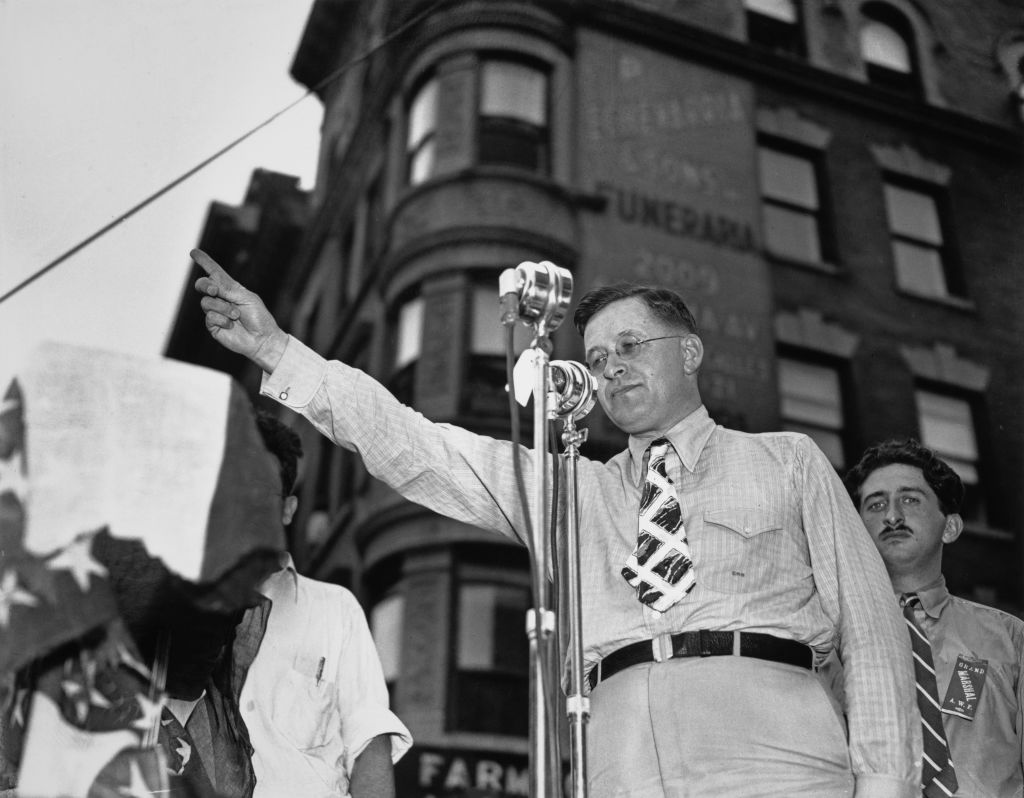
Elmer Benson addresses a rally sponsored by the American League Against War & Fascism, Harlem, New York, United States, August 7, 1932. (UPI / Bettmann Archive / Getty Images)
On an afternoon in March of 1937, Minnesota governor Elmer Benson arrived on the scene in a small town called Albert Lea where, the mayor warned him, things were on the verge of “bloody civil war.” Over the past week, the Independent Union of All Workers (IUAW) had been locked in a struggle with Helmer Myre, a former pro wrestler and rabidly anti-union sheriff. After deputizing a crew of local men and stockpiling a gymnasium full of guns, clubs, and explosives, Myre proceeded to bombard the town union hall, eventually drawing out a group of coughing tradesmen and women with gas bombs and torpedoes.
The mayhem continued as the unionists were jailed, but not long before laborers from neighboring towns caught wind of the trouble and rushed to their defense. Nearly two thousand angry, working-class Minnesotans surrounded the jail, breaking its window with a ball of porcelain waste drippings. Myre and his deputies were forced to retreat inside. Governor Benson, suffering from an ulcer, arrived in fury. “I order you on my responsibility to turn those people loose,” he screamed at Sheriff Myre, adding, “and I’m going with you to see that you do it properly.”
Benson was the last governor from the Minnesota Farmer-Labor Party, an alliance of agrarians, proletarians, progressives, and radicals that, in the 1920s and ’30s, easily beat out Democrats and became the Minnesota Republican Party’s main competition. In 1930, the party elected Governor Floyd Olson, whose charisma, deftness, self-described “radical” views, and third-party status made him a national symbol of the Popular Front era. In 1936, in the midst of a campaign for US Senate, a short but fatal battle with stomach cancer cut short Olson’s prospects of winning the election. That November, as the state reeled from the Farmer-Labor governor’s sudden death, Elmer Benson hit a high-water mark in the race to succeed Olson’s final term, winning 61 percent of the vote. Historians often treat the single biennial term that followed as an uneventful coda to Floyd Olson’s legendary five years in power. Yet, for socialists, Benson’s tenure is arguably more instructive. There’s little question that he was more radical than Olson, or, for that matter, anyone else to have governed an American state.