The Black Working Class Can No Longer Be Ignored
Across the political spectrum, Americans whitewash the working class and exclude labor struggle from black history. Blair LM Kelley’s Black Folk: The Roots of the Black Working Class is a necessary corrective — and provides lessons for struggle today.
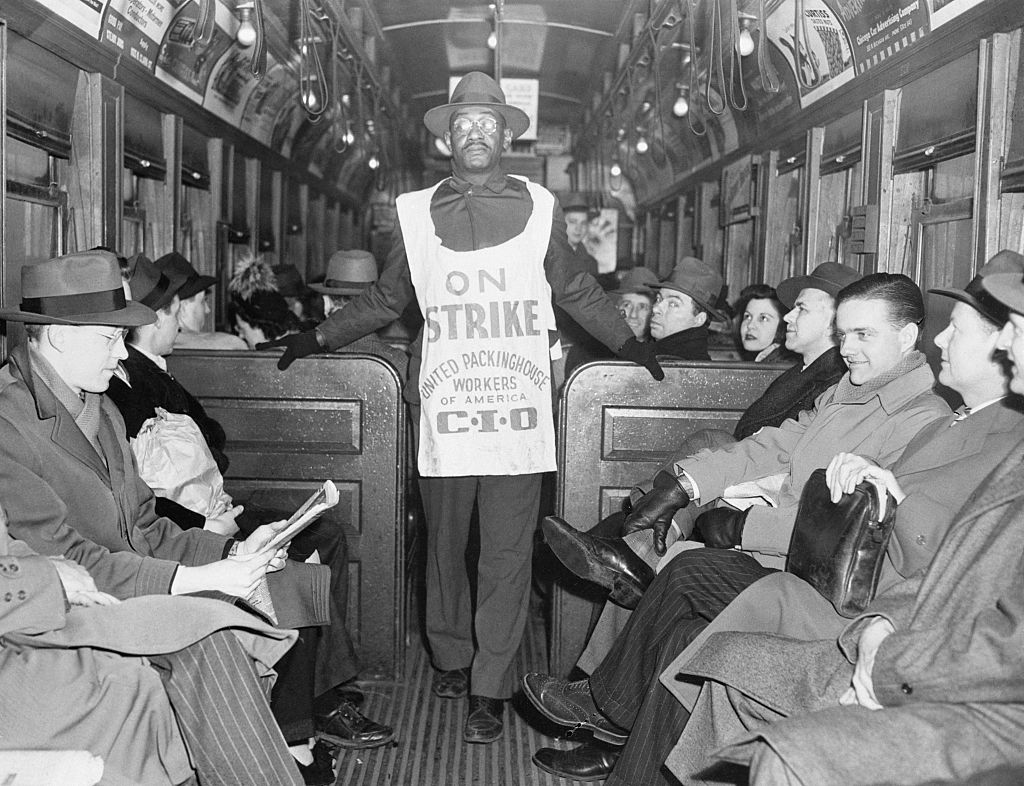
A black picketer walks through an all-white train car in Chicago during the United Packinghouse Workers of America strike of 1948. (Bettmann / Getty Images)
Florida’s new history curriculum, generated in the wake of Governor Ron DeSantis’s “Stop WOKE Act” and approved earlier this summer, will teach students that the institution of American slavery provided some benefit to enslaved workers by giving them valuable skills. While it’s true that newly freed peoples entered the economy with skills learned on plantations, it is also true that a violently enforced racial hierarchy demanded these skills be put to use for the ultimate benefit of the white economic elite. A rapacious industrial capitalist class awaited these new wage laborers, ready to take full advantage. Freed black men and women relied on interdependent networks of mutual aid, education, and labor organizing to leverage their skills into decent jobs where possible. The effort to do so, spanning a century and a half and still ongoing, is the story of the black working class.
This history of black labor struggle is obscured in the dominant account of the black American experience. Slavery is about corporeal brutality, Reconstruction about statehouses, Redemption about burning crosses, Jim Crow about water fountains, the civil rights movement about firehoses — all of it true enough, but conspicuously none of it about work. And yet work is always in the background, from the fundamentally unfree labor compact called slavery to Martin Luther King Jr’s final speech to striking sanitation workers in Memphis the night before his assassination. It’s this suppressed labor history that author Blair LM Kelley attempts to reclaim with care and compassion in her new book Black Folk: The Roots of the Black Working Class.
When we picture the working class, we typically conjure images of white coal miners with their faces made black by the indiscriminate application of coal dust. Or perhaps we think of industrial factory skeletons in places like Michigan and Pennsylvania — and we imagine that the workers who made a decent living in them were all white, even though many were black. Everyone colludes in this whitewashing of the working class. The conservative image of the working class is presented as mostly white, mostly male, and in opposition to the struggle for racial justice. Meanwhile, in liberal spaces the working class is largely seen as mostly white, mostly male, and an unfortunate collateral casualty of trade deals and technological advances.