Germany’s Support for Ukraine Faces Doubts on the Home Front
NATO’s Vilnius summit is placing fresh demands on Germany to increase its military aid to Ukraine. Foreign Minister Anne Baerbock speaks stridently of the West’s role in the war — but Germans are increasingly reticent about it.
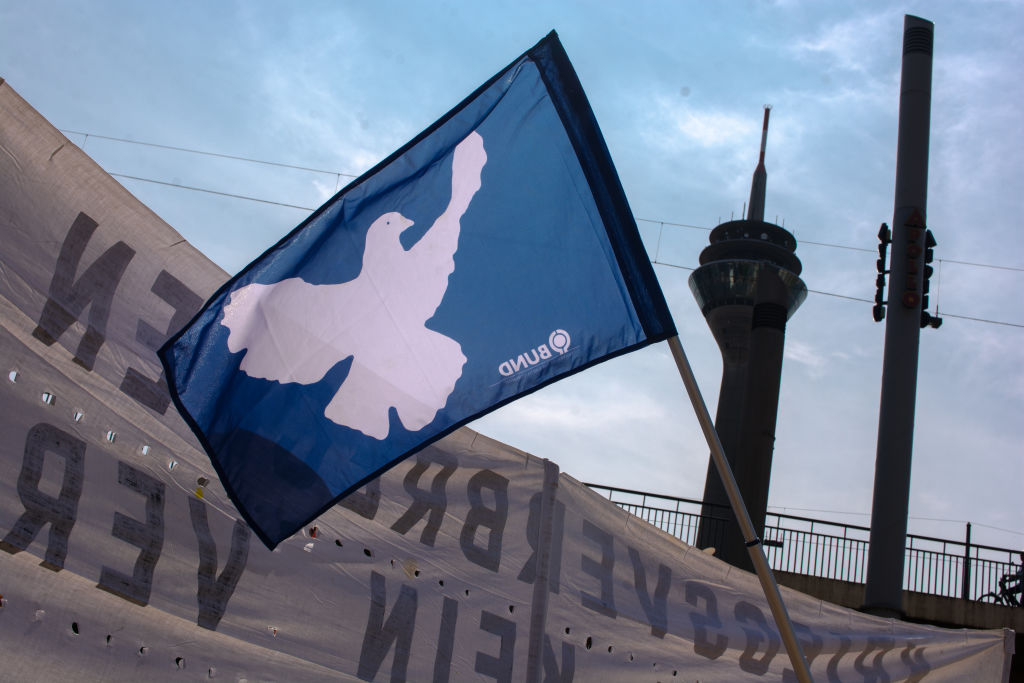
A protest in Johannes Rau Square in Duesseldorf, Germany on June 17, 2023, against German government policy providing military aid to Ukraine. (Ying Tang / NurPhoto via Getty Images)
As representatives from at least thirty-two countries met for the NATO summit in the flag-draped Lithuanian capital city, some topics were almost certain to come up. Attendees are discussing Sweden’s membership and F-16 fighter plane training regimes, nuclear threats, and even this month’s record global temperatures. Yet other topics that have lit up discussion in Germany will be studiously avoided — the bombing of the Nord Stream pipelines likely among them.
The possibility that the United States was partially or fully responsible for the bombing of the pipelines has been downplayed by diplomats and leaders in both countries. Left-wing German politician Sevim Dağdelen mocked leaders in the Bundestag after the publication of an article on the bombing’s likely American origins by respected journalist Seymour Hersh. After his analysis was largely ignored by German leadership, she remarked:
Maybe we don’t need to jump to the assumption that Federal Chancellor [Olaf] Scholz and Federal Foreign Minister [Annalena] Baerbock wouldn’t even venture out to buy a loaf of bread without first getting permission to do so from the US administration.