Germany’s Bigger Defense Budget Won’t Make Anyone Safer
- Loren Balhorn
German chancellor Olaf Scholz has just committed €100 billion to defense spending. The move is widely touted as a strong response to Russian aggression — but is more about showing Germany’s fealty to US global foreign policy objectives.
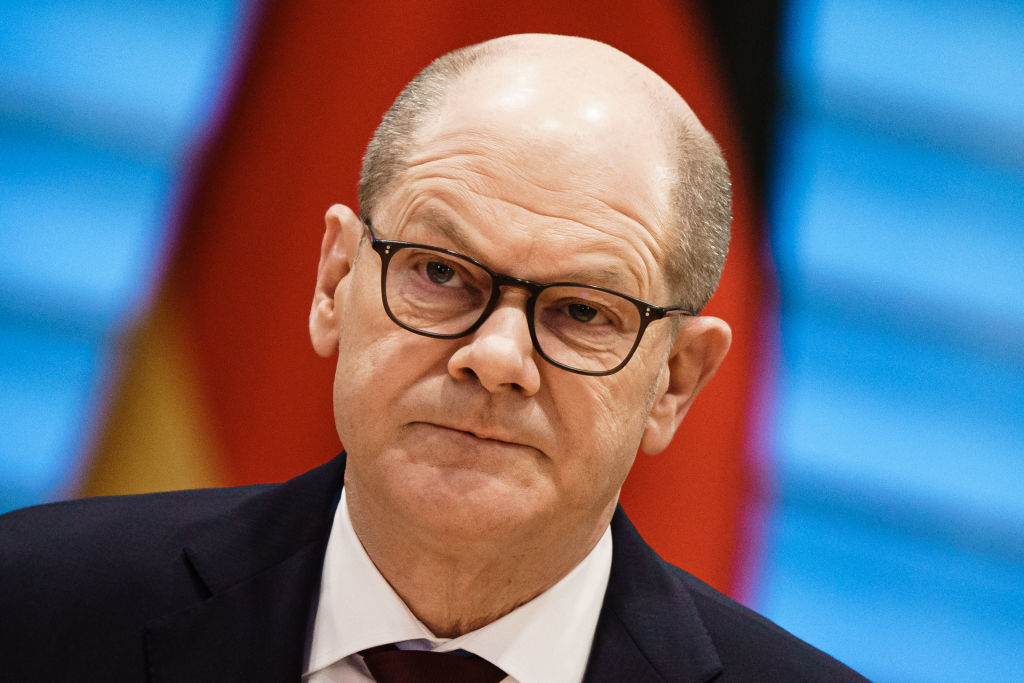
German chancellor Olaf Scholz looks on with glasses during the beginning of a meeting of the security cabinet on March 7, 2022, in Berlin, Germany. (Clemens Bilan – Pool / Getty Images).
Over the past week, the German press — which has been even more self-censorious than usual lately — was full of headlines celebrating German chancellor Olaf Scholz’s announcement of a one-off, €100 billion supplement to the country’s so-called “defense budget.” The additional funding, to be spread out across an undetermined number of years, allegedly marks a radical about-face from Angela Merkel’s policies, now discredited by the turn of events in Ukraine.
In truth, however, the budget increase constitutes a fitting continuation of her style: a momentary concession to domestic and international sentiment, political symbolism, “sending a signal” with the goal of “setting an example” — regardless of what that signal actually means, so long as it only has to mean something later on (and who knows when that will be). So, what’s all the fuss about?
2 Percent Pledge
In 2002, in the context of the admission of the Baltic states as well as Bulgaria, Romania, and Slovakia (in the second of three waves of NATO eastward expansion), NATO’s member countries pledged to the United States that they would spend 2 percent of their GDP on arms. Exactly what kind of arms were to be purchased was left open. In practice, this mostly entailed high-tech weaponry with a global operating range — the kind that is so strategically dear to the United States’ heart.