France’s Police Unions Are Mobilizing to Defend Their Impunity
The police killing of a 17-year-old in a Paris suburb has sparked a revolt against state violence across France. But powerful police unions have closed ranks behind the killer, in a backlash that shows French cops’ refusal to accept even basic accountability.
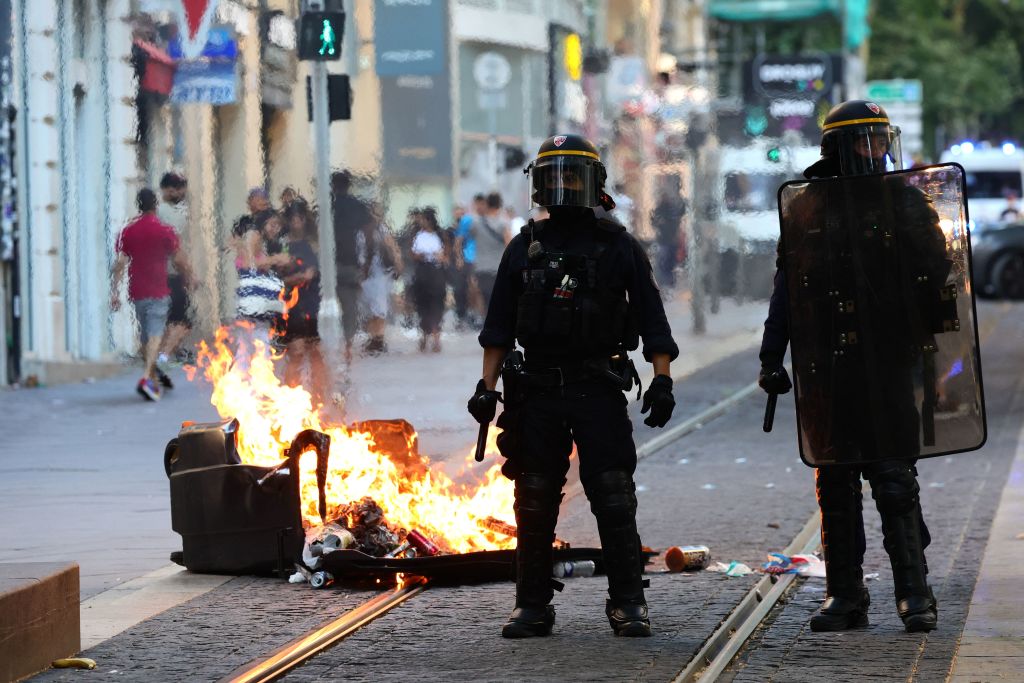
French riot police officers stand guard next to a burned-out trash bin during a demonstration against police in Marseille, southern France on July 1, 2023. (Clement Mahoudeau / AFP via Getty Images)
This Tuesday, Nahel, a seventeen-year-old of Franco-Algerian origin, was shot and killed by a police officer during a traffic stop in the Paris suburb of Nanterre. The young man’s death — and footage of the scene that looks to many like an execution — has set off a powder keg nationwide. For the last few days, major urban areas and small regional cities alike have seen a wave of protests, rioting, and looting. Many commentators are comparing the events to the 2005 uprising that followed the death of two men of color as they were chased by police north of Paris. On Thursday, thousands attended a march in Nanterre alongside Nahel’s family and anti–police violence activists. As of Saturday, upward of two thousand people have been arrested, with hundreds of police officers injured in the clashes.
Kicked off by Nahel’s killing, this has morphed into a revolt against policing and its role in the broader exclusion faced by minorities in France. It’s feeding off the accumulated experience of many forms of harassment and daily violence by the police, from cheap verbal abuse (of which just about everyone I spoke to at Thursday’s march seemed to have a story) to the industrialized use of minor-offense fines against working-class communities of color. France’s strict laws regulating statistics make it very difficult to collect concrete information on the effects of racism. But a 2017 report from France’s Rights Defender, a public watchdog, suggests that young men perceived as black or Arab are twenty times more likely to be stopped for an ID check than French people perceived as white.
These are the facts. Yet it’s difficult to get past the impression that France is woefully ill-equipped for confronting the death of a young man like Nahel — or the unavoidably political meaning of the revolt that has resulted from it.