US Sanctions Are Brutal and Inhumane. And They Don’t Work.
Sanctions are a form of collective punishment. Their costs are overwhelmingly borne by innocent people rather than governments. And they are just another form of war, not an alternative to it. The US’s many sanctions across the world need to end.
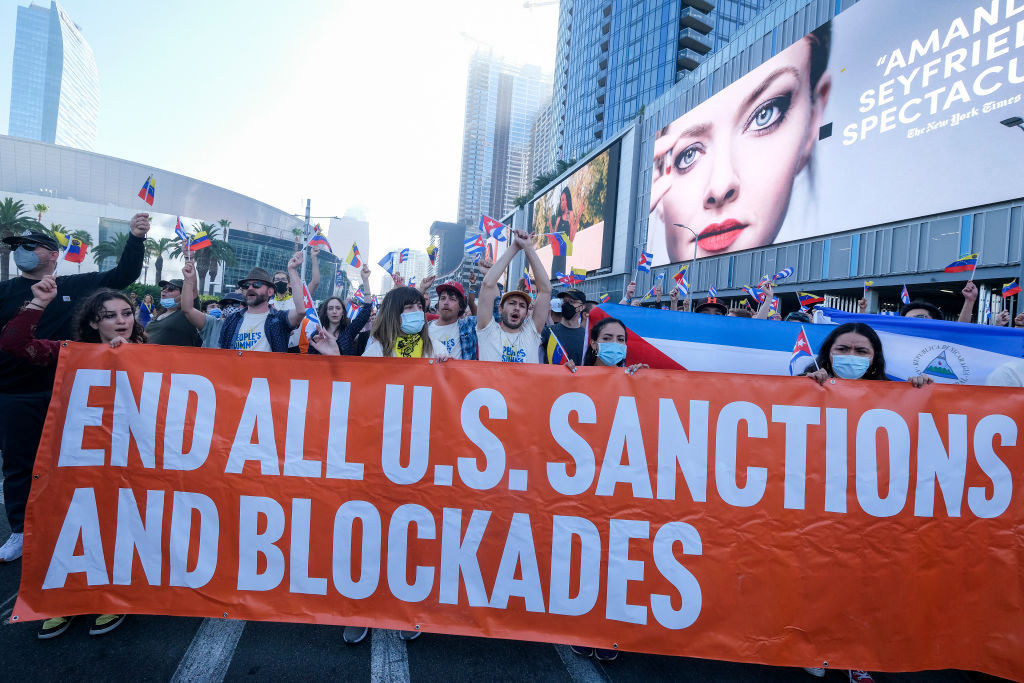
Activists protest outside the 9th Summit of the Americas at the LA Convention Center to deliver a letter rejecting President Joe Biden’s policy of sanctions, exclusions, and blockades against Latin America and the Caribbean, in Los Angeles, California, on June 10, 2022. (Ringo Chiu / AFP via Getty Images)
The US government is sanctioning so many countries right now, it’s hard to keep track of them all.
There are the countries you probably know about, like Russia, Syria, Iran, and Venezuela. There are the ones you hear less about, like Nicaragua, Yemen, Afghanistan, and Myanmar. And then there are the official enemies that Washington has sanctioned for decades, like Cuba and North Korea.
These sanctions are presented to the public as a nondestructive, even humane alternative to military action. But a new report from the Center for Economic and Policy Research (CEPR) lays out the brutal and damaging reality of sanctions regimes and their human costs. Synthesizing the findings of dozens of studies and examining the sanctions’ impact on three targeted countries in particular, the CEPR study makes clear what critics of the policy have long stressed: that sanctions are a form of collective punishment, whose costs are overwhelmingly borne by the innocent people ruled by the often undemocratic governments US officials seek to punish and which is in practice not so much an alternative to war as an alternative form of it.