On the Debt Ceiling, Joe Biden Doesn’t Have to Capitulate to Republican Hostage-Taking
Don’t let the Democrats tell you Joe Biden’s hands are tied on the debt ceiling. If he really wanted to, he could use any number of maneuvers to refuse Republicans’ anti-worker, anti-poor demands and still avoid default.
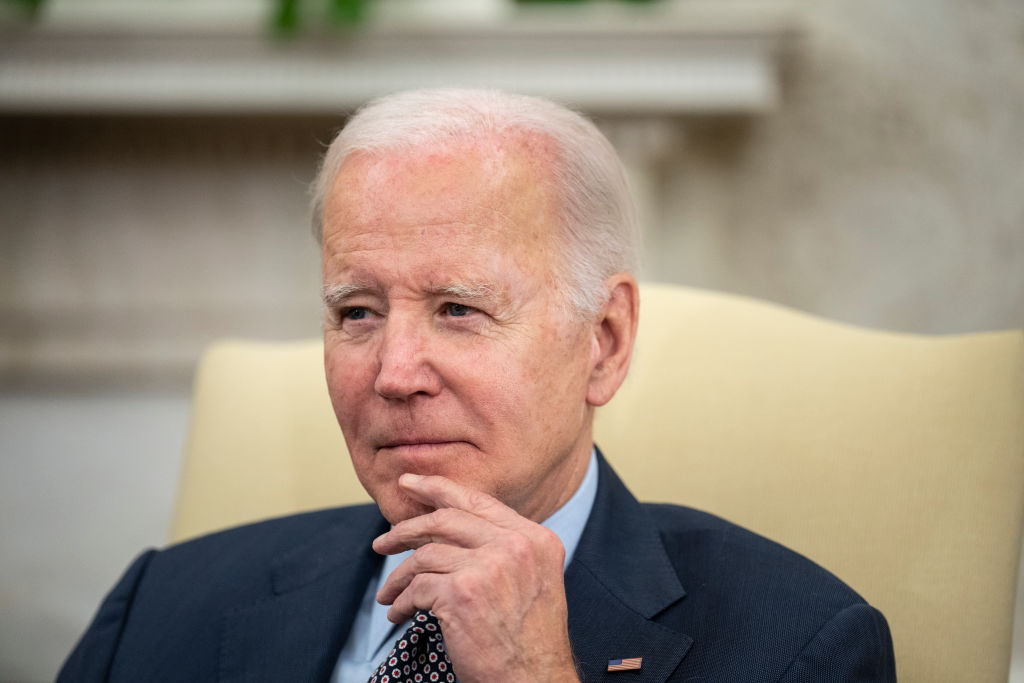
Joe Biden meets with House Speaker Kevin McCarthy in the Oval Office of the White House on May 22, 2023 in Washington, DC. (Drew Angerer / Getty Images)
Within the US constitutional system, the power to make laws is vested in Congress. This power includes the power to raise revenue through taxation and other means, to borrow money, and to engage in public spending. The president is then required to execute these fiscal laws as written.
There is a potential problem in this structure, which is that Congress could pass laws directing the president to spend a certain amount of money without passing laws to finance that spending. In this scenario, it is impossible for the president to follow the law. If he executes the spending by unilaterally financing it through tax hikes, bond sales, or similar, then he has usurped financing authority that is vested solely in Congress. If he unilaterally forgoes some or all of the spending mandated by Congress in order to stay within the financial constraints, then he has usurped the spending authority that is vested solely in Congress.
As far as I know, this potential problem has never arisen historically. Before 1917, Congress financed all of the spending it mandated, including by authorizing each and every bond sale. After 1917, Congress made it so that the president was always authorized to sell bonds in order to finance any spending that exceeded other revenue sources. So, in this scenario, bond sales became the residual funding mechanism used to ensure that the following equation was always in balance.