American Capitalism Has Produced Its Most Remarkable Innovation Yet: Breadlines
Soviet Russia’s food shortages were frequently held up as proof of the Communist system’s failure to provide for its citizens. But here in hyper-capitalist America, tens of millions of people are going hungry.
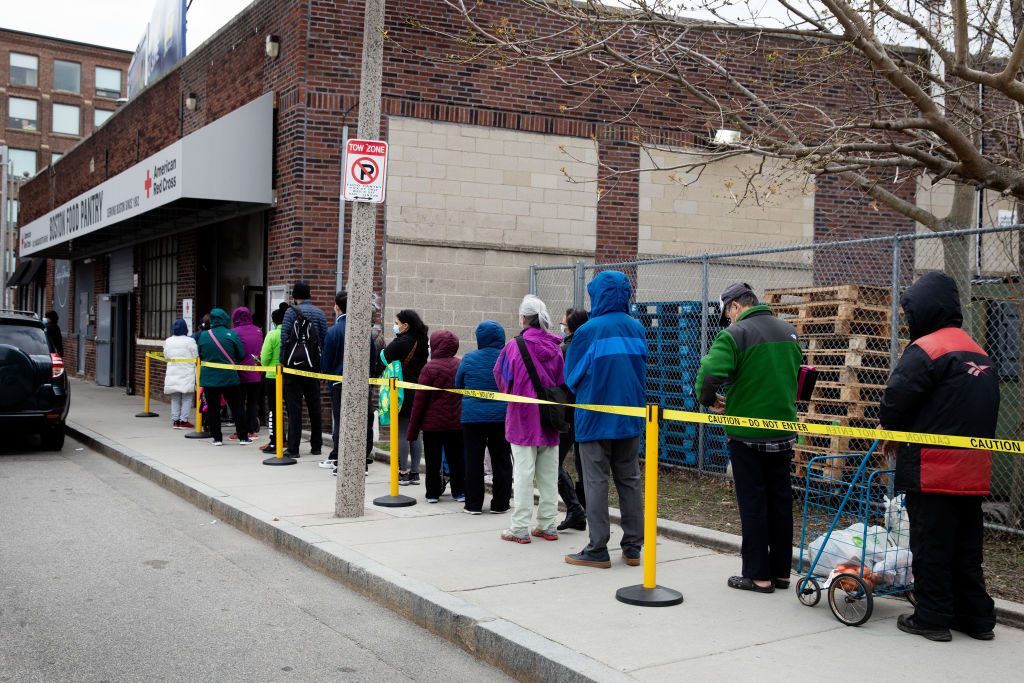
Food bank clients line up outside the American Red Cross Food Pantry in Boston, Massachusetts, on April 26, 2023. (Kayana Szymczak / Bloomberg via Getty Images)
On January 22, 1992, America’s newspaper of record published a front-page report detailing the long lines still appearing in Moscow and other Russian cities as hungry citizens sought out bread. Several weeks earlier, the USSR had finally collapsed, and breadlines — much as they had during the Cold War — persisted as the de facto symbol of the country’s dysfunction and crippling economic inefficiency.
“In Russia, Long Lines for Plentiful Bread,” blared the New York Times headline, accompanied by a report from journalist Louis Uchitelle that detailed lengthy waits despite the country’s ample supplies of grain and flour. “The bottlenecks that make Muscovites and the residents of other major cities anxious about bread shortages,” wrote Uchitelle, “are not, so far, in the supplies of grain and flour. The problem instead lies in the methods used by the state-owned industry to make and distribute bread.”
Various inefficiencies were documented, among them an incentive structure that perplexingly encouraged retailers to throw out day-old stock and order less bread than they might have been able to sell. Distribution was reportedly poor because there weren’t enough trucks to move goods, and single-cashier service at the point of sale created massive bottlenecks. Thanks to the recent relaxation of price controls, the cost of bread was also soaring.