When a Fight Against Sexual Assault Bolstered Mass Incarceration
A new documentary revisits Stanford student Brock Turner, who was convicted of sexual assault but served only three months in jail. Feminists led a recall effort against the case’s judge — but actually led judges to favor harsher sentencing across California.
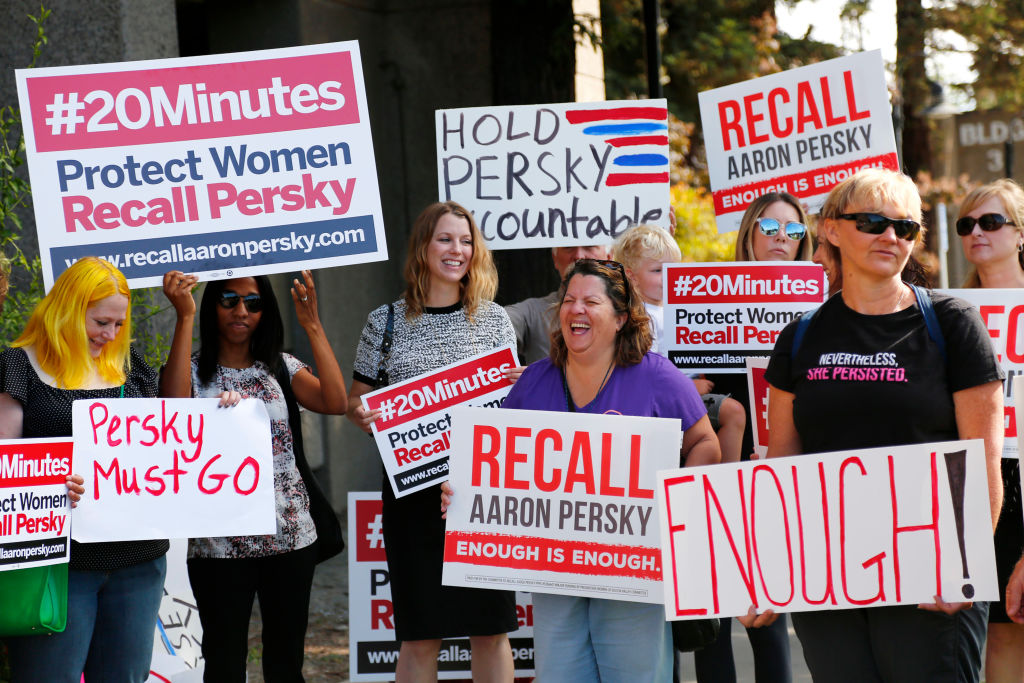
Protesters prepare to deliver a notice of intent to recall Superior Court Judge Aaron Persky at the Santa Clara County Registrar of Voters office in San Jose, California on June 26, 2017. (Gary Reyes / Bay Area News Group via Getty Images)
In 2016, Brock Turner was convicted of three counts of felony sexual assault. The woman he’d assaulted, Chanel Miller, had been unconscious at the time; Turner assaulted her after a party, behind a dumpster on the Stanford University campus, where he was a freshman.
Before Judge Aaron Persky of Santa Clara County’s Superior Court decided the sentence, Miller read a statement, addressing Turner directly. She detailed how she had only gone to the party to spend time with her younger sister, and how she had gotten drunk because she’d forgotten how much her tolerance for alcohol had decreased since college. She said that the next thing she remembered shortly after arriving at the party was waking up in the hospital, covered in pine needles and bruises.
Turner was facing up to fourteen years in prison, but Judge Persky only sentenced him to six months in jail, as well as mandatory registry as a sex offender. Television commentators described the sentence as a “slap on the wrist for a privileged, white sexual offender at an elite university.” The blond-haired Stanford student, a star athlete on the school’s swim team, had gotten a few months; others with less privilege have received, for example, a life sentence for selling thirty dollars’ worth of marijuana.