Free-Market Idolatry and Hatred of Democracy Go Hand in Hand
The wildest fantasy of hypercapitalist ideologues isn’t to expand democracy but to avoid its reach or even snuff it out.
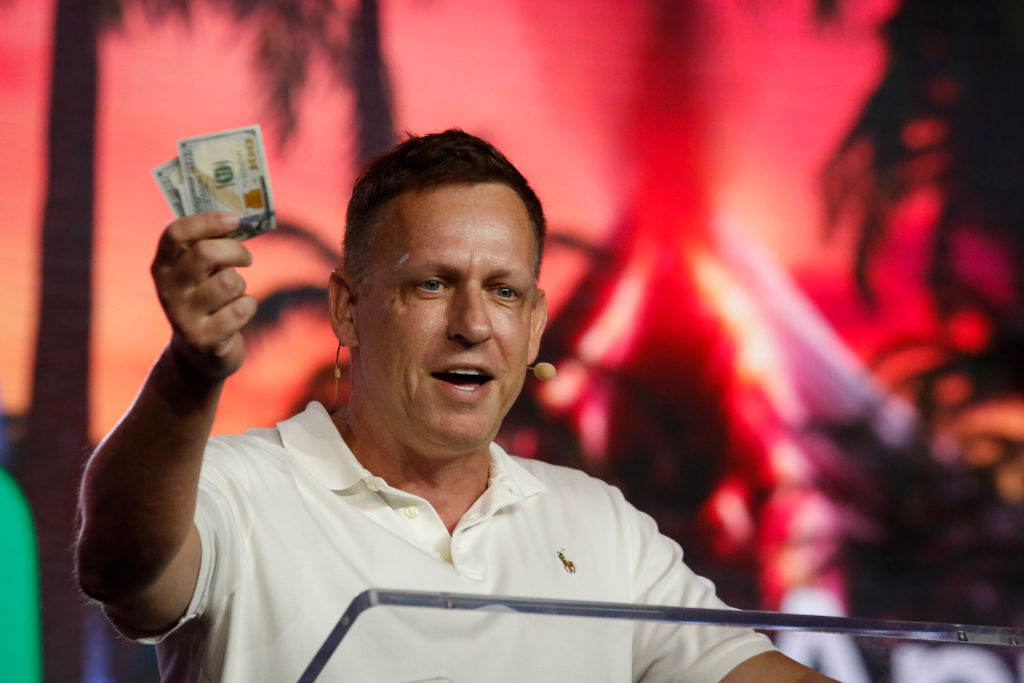
Billionaire Peter Thiel speaks during the Bitcoin 2022 Conference at Miami Beach Convention Center, April 2022. (Marco Bello / Getty Images)
After reading historian Quinn Slobodian’s new book, you are not likely to think about capitalism the same way. As one blurb aptly put it, the story is “head-spinning,” and, by the way, great fun to read. Slobodian is a professor of the history of ideas at Wellesley College and bearer of one of my favorite Pynchonesque names on the internet, along with Match Esperloque and Con Skordilis. His style and subject matter call to mind the recently departed Mike Davis.
Slobodian’s book gets off to a great start, because it speaks to one of my pet peeves about the US left: we tend to think of public policy in exclusively national terms, as if we were a unitary state like France. The reality is that the US federal system, with over ninety thousand local governments, is the most decentralized in the world save for Switzerland. US states are sovereign entities with substantial independent authority; local governments are creatures of their respective state governments.
There are thousands of zones throughout the world. The United States put its toe in the water in the 1980s during the Reagan Administration, proposing “enterprise zones” as a solution to urban blight. These have never amounted to much, though not for state and local governments’ lack of trying. Enterprise zones have mostly been an opportunity for business firms to practice locational arbitrage, moving in operations they would have carried out elsewhere for the sake of tax breaks and lax regulation. In fact, such arbitrage is part of the plan, the idea being to erode state restrictions by presenting competitive advantages in zones.