In the Post-9/11 Media Landscape, the Fake News Was Coming From Inside the House
Twenty years ago, George W. Bush and Tony Blair lied their way into invading Iraq. The mainstream media cheered them along.
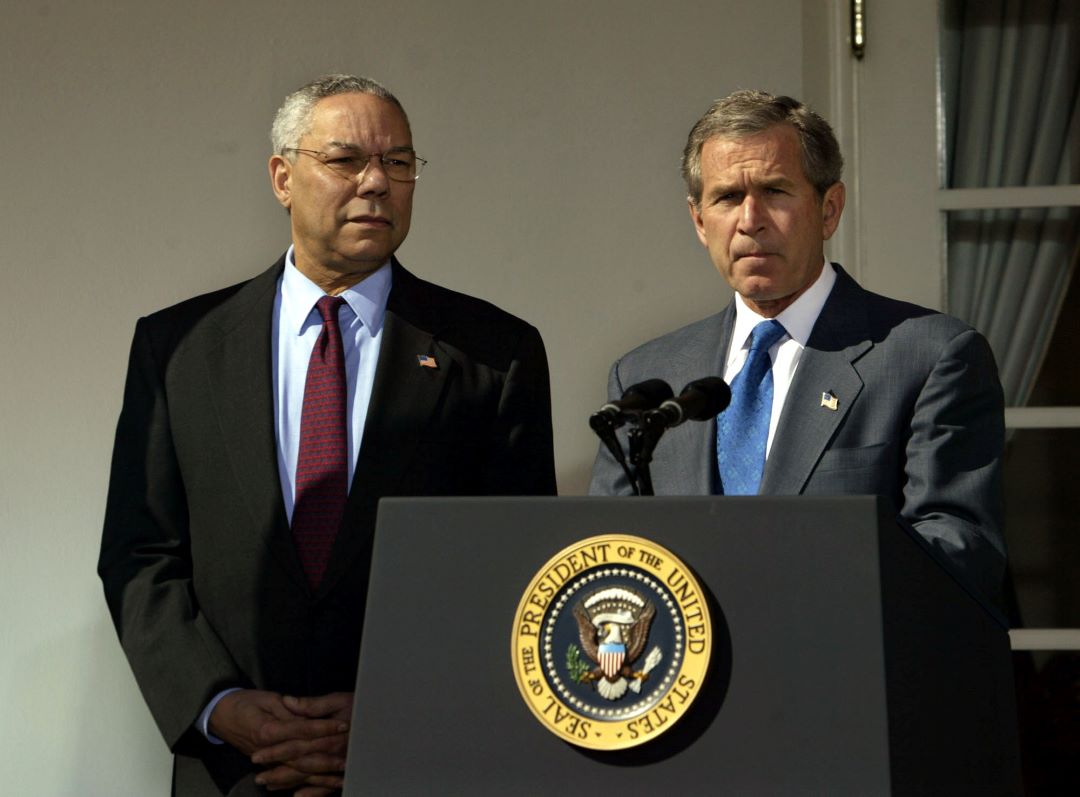
President George W. Bush speaks in the Rose Garden of the White House, flanked by Secretary of State Colin Powell, in Washington, DC, on March 14, 2003. (Chris Kleponis / Bloomberg via Getty Images)
In April 2003, BBC political editor Andrew Marr made an effusive broadcast from the steps of Number 10 Downing Street. Earlier that day, less than a month after their initial invasion, coalition forces had taken Iraq’s capital. As Marr gleefully reported, the mood inside the British prime minister’s office was one of elation.
The capture of Baghdad, he announced, had put an end to “the faint air of pointlessness” and stench of “tawdry arguments and scandals” that had been hanging over the prime minister. All doubts about Tony Blair, his government, and the assault on Iraq, Marr proclaimed, could be safely consigned to history’s dustbin. In praising Blair, he then threw all caution to the wind:
Mr Blair is well aware that all his critics out there in the party and beyond aren’t going to thank him — because they’re only human — for being right when they’ve been wrong. And he knows that there might be trouble ahead, as I said. But I think this is very, very important for him. It gives him a new freedom and a new self-confidence. . . . I don’t think anybody after this is going to be able to say of Tony Blair that he is somebody who is driven by the drift of public opinion or focus groups or opinion polls. He took all of those on. . . . It would be entirely ungracious, even for [Blair’s] critics, not to acknowledge that tonight he stands as a larger man and a stronger prime minister as a result.