Energy Politics Will Define the Future of Europe
Russia’s invasion of Ukraine transformed the energy politics of Europe: America became Germany’s main importer of liquid natural gas and Putin pivoted east. This new order is likely to generate more conflicts than the one that came before it.
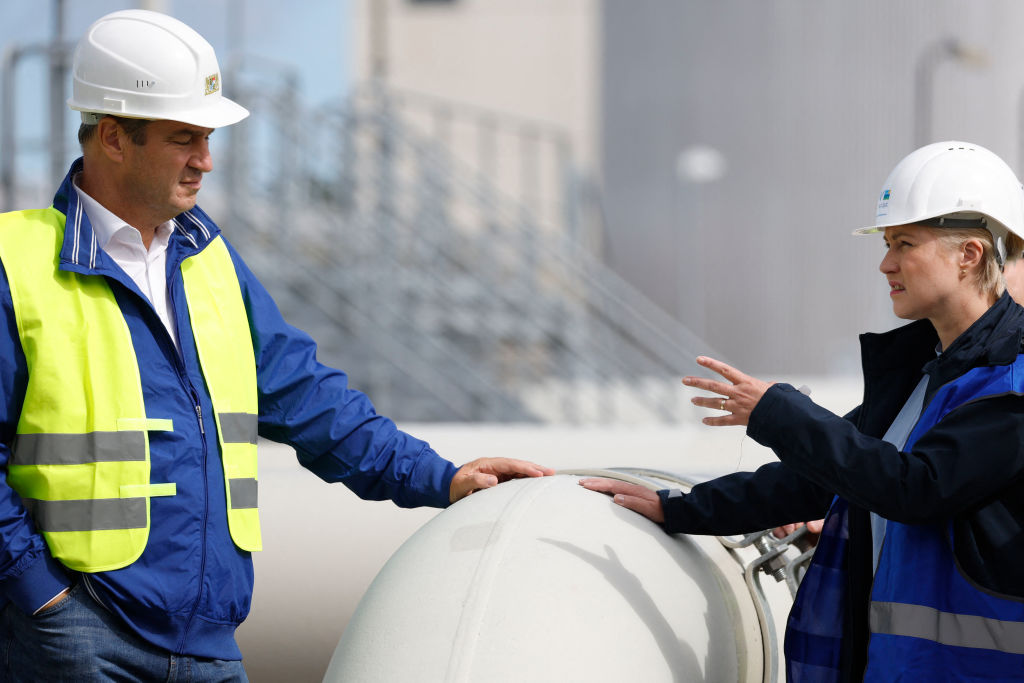
Manuela Schwesig (R), state premier of the federal state of Mecklenburg-Western Pomerania, and Markus Soeder, state premier of the federal state of Bavaria, visit a site of Gascade and Deutsche ReGas where it is planned to feed the existing OPAL/NEL pipeline network with liquefied natural gas Lubmin, Germany, on August 30, 2022. (Odd Andersen / AFP via Getty Images)
Almost overnight, Russia’s invasion of Ukraine transformed energy politics and disrupted supply chains around the globe. Europe and the international community are now having to reckon with a world in which the largest energy oil producer is having to accommodate itself to a situation of increased economy autarky.
On the day of Russia’s invasion, Helen Thompson, a professor of political economy at the University of Cambridge, published Disorder: Hard Times in the 21st Century. Her book, which outlines the geopolitical fault lines caused by global energy production and distribution, spoke to a moment in which Europe faced its greatest conflict since the end of World War II.
Thompson spoke to Jacobin about the extent to which Russia’s invasion has upturned the energy politics of Europe and the world. This interview has been edited for readability and clarity.