The Capitalist Road to Serfdom
Some multinational corporations are now larger and more powerful than individual nation-states. If those companies were countries, they would be authoritarian dictatorships.
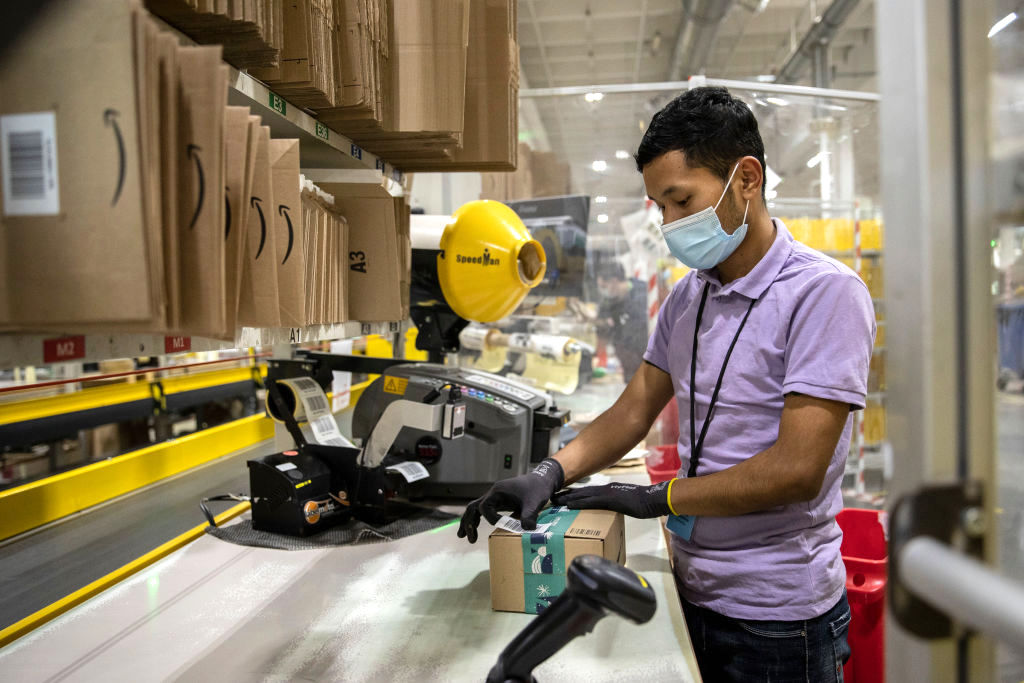
A worker packs items while fulfilling orders at an Amazon warehouse on November 18, 2021 in Brieselang, Germany. (Maja Hitij / Getty Images)
There is a long-standing right-wing caricature of what life might look like in a socialist society, typically something resembling Arthur Koestler’s Darkness at Noon or George Orwell’s Nineteen Eighty-Four: daily life is highly regimented; the state is centralized and all-pervasive; dissent and freedom of speech are severely curtailed; surveillance is panoptic and constant; absolute loyalty is expected of citizens, who are disciplined if they break from the party line; and elections, if held at all, are a sham.
The great irony of this dystopian sketch, given who tends to invoke it, is that its closest analogue today is actually found in the modern, multinational corporation.
By design, the corporation is not a democratic enterprise. Its management is hierarchical, its imperatives are growth and profit, and its structure is a de facto class system of owners, managers, and workers. You could argue that in the earliest days of capitalism, something like the concept of free enterprise actually existed: firms of various sizes competed, with even the largest dwarfed in both size and influence by most nation states. Today, the world’s biggest companies not only wield monopolistic power and exert considerable political influence, but in many cases have market capitalizations exceeding the GDPs of entire countries.