Employers Are Running Unchecked Workplace Dictatorships Across America
Under free and democratic conditions, millions of American workers would probably join a union tomorrow. Thanks to laws heavily slanted toward bosses, unionization votes resemble the sham elections of tin-pot dictatorships.
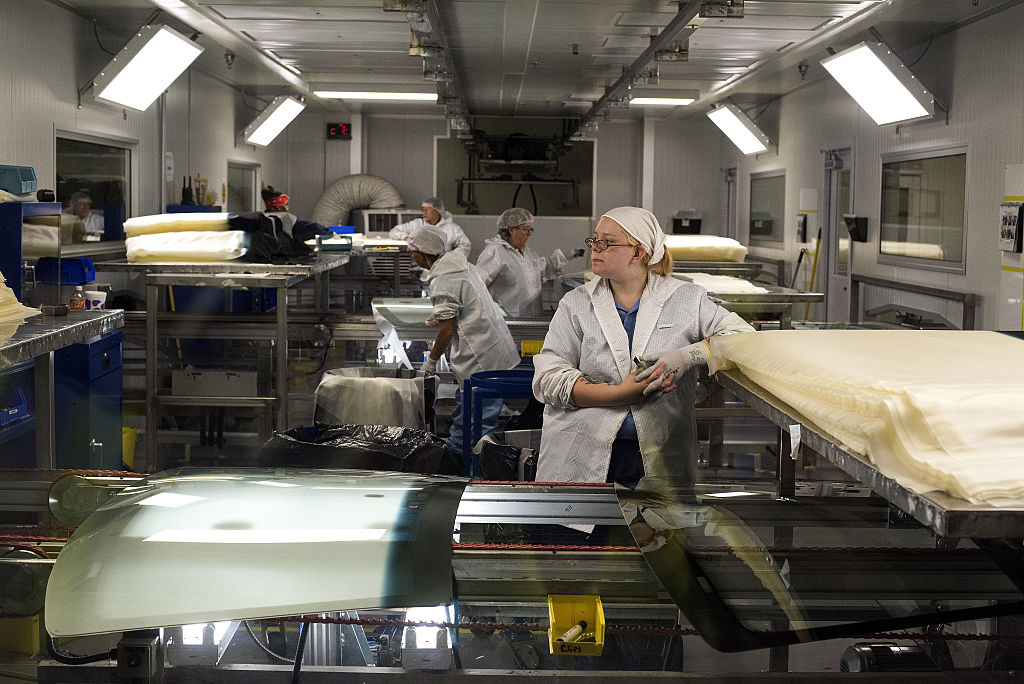
Employees work on an assembly line at a glass production facility in Moraine, Ohio. (Ty Wright / Bloomberg via Getty Images)
As of January, the Bureau of Labor Statistics estimated that some 14 million American workers (or just over one in ten) currently belong to unions, less than in 2020. And despite courageous and well-publicized union drives at places like Starbucks and Amazon, union density has continued its long-term decline — down by nearly 50 percent since 1983 when the membership rate was just over two in ten workers. This isn’t, it must be said, because workers don’t want to join unions. Last year, in fact, Gallup found public support for them at a near supermajority of 65 percent, the highest measured since 1965. And according to the latest survey data, nearly half of current nonunion workers want to join a union.
So, what accounts for the disjuncture between this high level of support and actual union membership? A broad answer is that unions have been under concerted political attack since at least the Ronald Reagan era. More specifically, though, America’s existing laws make unionizing a workplace an often impossible task — effectively allowing employers to rig elections outright if they even happen at all. Such is the subject of a recent study by labor scholar Gordon Lafer, which details the many ways in which union elections take place in an environment controlled near exclusively by employers, more closely resembling sham elections in a dictatorship than those in a democracy.
That’s partly due to the illegal and heavy-handed tactics often used by bosses to prevent or dissuade their workers from organizing. As Lafer writes: