Poland and Hungary Are Testing the Limits of the EU’s Liberalism
Before their illiberal turn, Poland and Hungary were lauded as postcommunist poster children. Both nations have combined moderately redistributive welfare states with attacks on civil liberties — but inflation is putting their growth model to the test.
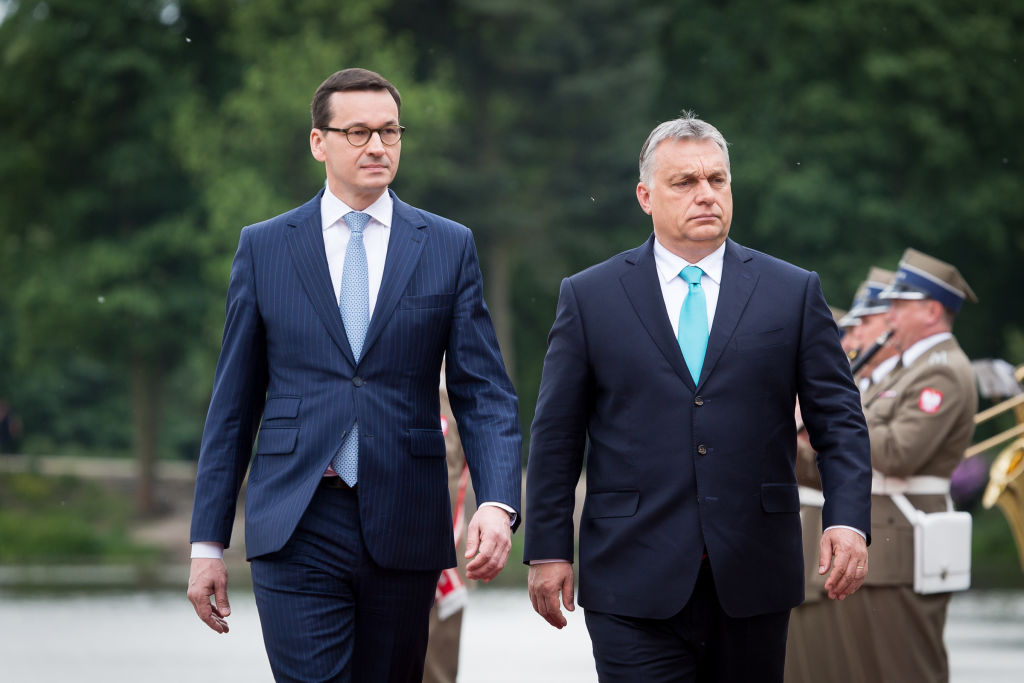
Polish prime minister Mateusz Morawiecki welcomes Hungarian prime minister Viktor Orbán in front of the Lazienki Palace in Warsaw, Poland on May 14, 2018. (Mateusz Wlodarczyk / NurPhoto via Getty Images)
Since 2010, Viktor Orbán, the prime minister of Hungary, has been at the head of an illiberal turn in the European Union. While Germany initiated a historical sea change — Olaf Scholz’s famous “Zeitenwende” — and France abandoned its conciliatory approach toward Russia, Budapest saw in this united front an opportunity to exert leverage. Using its veto, Hungary’s prime minister threatened to prevent funds flowing to Ukraine from the bloc last month unless €5.8 billion ($6.3 billion) of Hungarian-directed recovery funds, frozen because of graft within the nation, were released.
Orbán’s belligerence would perhaps not pose so serious a problem were it not for the fact that he is not alone in perusing illiberal policies. Domestically, the leaders of the Polish right-wing Law and Justice (PiS) government — while staunchly pro-Ukraine — have proved equally unwilling to give in to Brussels’s demands on the rule of law. Like its southern counterpart, Poland is badly in need of EU funds. Ostensibly, the conflict is about political values — a cosmopolitan and liberal core Europe up against its peripheral and nationalistic governments. However, there is more to the growing tensions than fears of democratic backsliding taking place in Poland and Hungary. At its heart lies a tension between an economy that is dependent on close relationships with the European core and a domestic politics which is hostile to its supposed ideals.
So far, the economic policy of the Eastern European “illiberal” governments has been remarkably resilient to external shocks, international pressures, or electoral discontent. How so? Because it is a creative blend of post-transformation Eastern neoliberalism with some good old-fashioned redistribution. Orbán and the Polish prime minister Mateusz Morawiecki reaped the fruit of globalization and used it to mediate its adverse effects.