Italy’s Crisis Is Rooted in a Decades-Long Neoliberal Offensive
This fall’s Italian elections saw voters punish the incumbent parties of government yet again. But behind the upheaval in the party system is a narrowing of real political choice, as working-class interests struggle to find electoral expression.
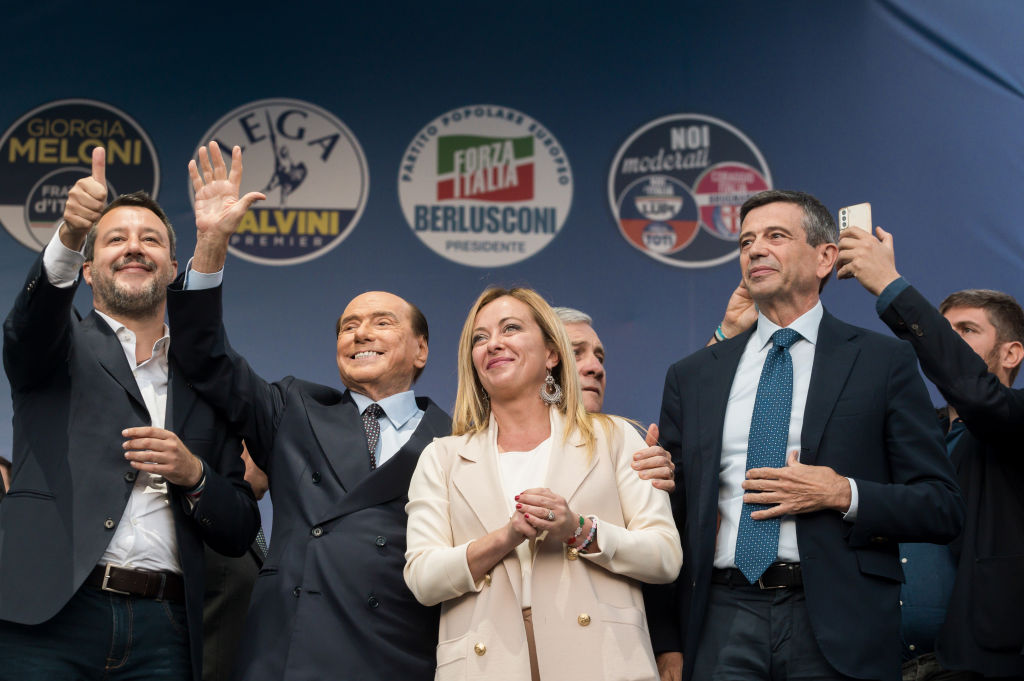
Matteo Salvini of the Lega, Silvio Berlusconi of Forza Italia, Giorgia Meloni of Fratelli d’Italia, and Maurizio Lupi of Noi Moderati attend a political rally in Piazza del Popolo in Rome, Italy on September 22, 2022. (Valeria Ferraro / SOPA Images / LightRocket via Getty Images)
Over the past three decades, Italians have been called to the polls nine times to elect a new Parliament; and nine times, the parties supporting the outgoing government have been defeated. The victory for Fratelli d’Italia, the only major force in opposition to Mario Draghi’s technocratic government, was thus hardly unpredictable. It was similarly no surprise that in the general election this September 25, voter turnout, which had already been in steady decline, hit a historic postwar low: little over three in five Italians now vote (almost nine in ten did so in 1992).
These simple figures tell us that the crisis that began with the dissolution of the leading parties of the “First Republic,” as Italians call the political order that reigned from 1946 to 1992, remains unresolved. But September’s result can be read as a perhaps decisive step forward in the restructuring of the Italian political landscape. Today’s picture is entirely consistent with the absolute dominance of neoliberal ideology, which took hold in the country between the 1980s and 1990s, and which largely produced the political crisis that has now been ongoing for three decades.
An essential distinction is to be made between the social alliances produced by political initiative, and the power relations in the ideological and cultural spheres. It is from the latter that we must start in order to grasp the specifics of the Italian situation, in which neoliberalism is now the almost exclusive reference point not only of political leaders but also of the vast majority of citizens.