Taiwan Shouldn’t Be Used as a Geopolitical Pawn
During the Cold War, US officials saw Taiwan as an “unsinkable aircraft carrier” and supported Chiang Kai-Shek’s dictatorship. Modern-day Taiwan has developed a democratic culture that shouldn’t be subordinated to confrontation between Washington and Beijing.
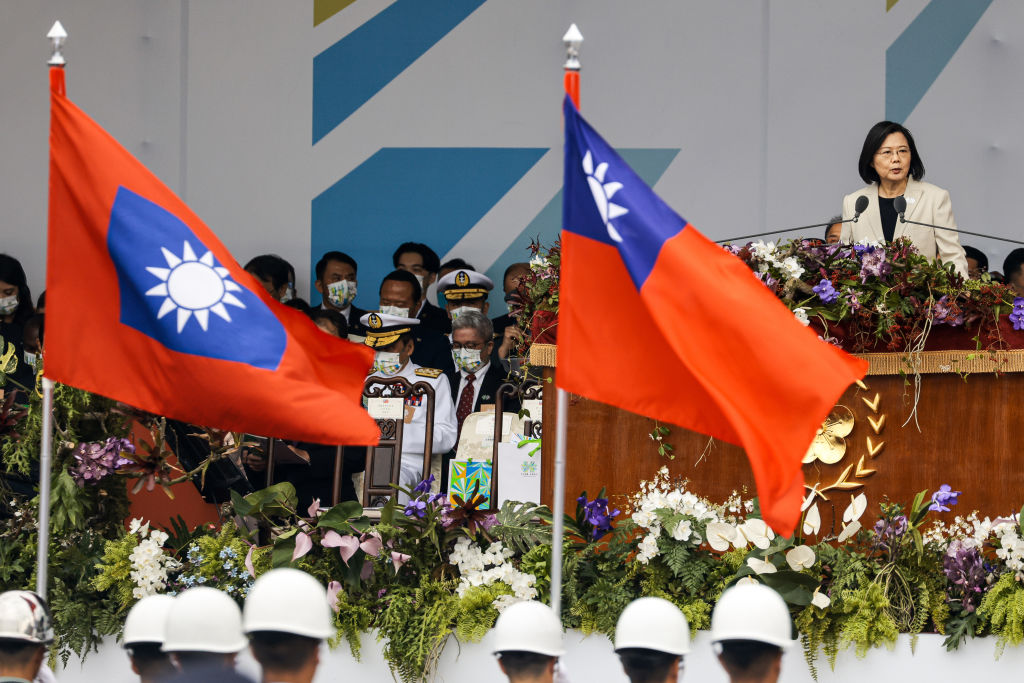
Tsai Ing-wen, Taiwan’s president, speaks during the National Day celebration in Taipei, Taiwan, on Monday, Oct. 10, 2022. (I-Hwa Cheng / Bloomberg via Getty Images)
On September 18, President Joe Biden was asked on 60 Minutes about the US commitment to defend Taiwan against a potential Chinese attack. His answer to the question “Would US forces defend the island?” was a blunt “yes.”
Since 1979, the official US policy has been to state that any change to the status quo in the Taiwan Strait by non-peaceful means would be of “grave concern” to the United States. Yet the 60 Minutes interview was the fourth time since coming to office that Biden has publicly stated the United States would defend Taiwan. His recent comments appear to have upped the ante, outlining a clearer commitment than US presidents have made in past decades.
Biden’s comments ignited a firestorm of both criticism and support. Some pointed to the recklessness of revising a long-standing US policy in a way that could draw Washington into a dangerous conflict. Others argued that such a commitment would provide necessary deterrence to an aggressive Beijing.