A Real, Live Communist Who Wrestled With the Real, Live Communist Party
If you believed the mainstream media portrait of Communism in the 1960s, you’d assume the Cubans, Russians, and Americans were in lockstep. But if you were inside the Communist Party USA, as Michael Myerson was, you knew the reality was far different.
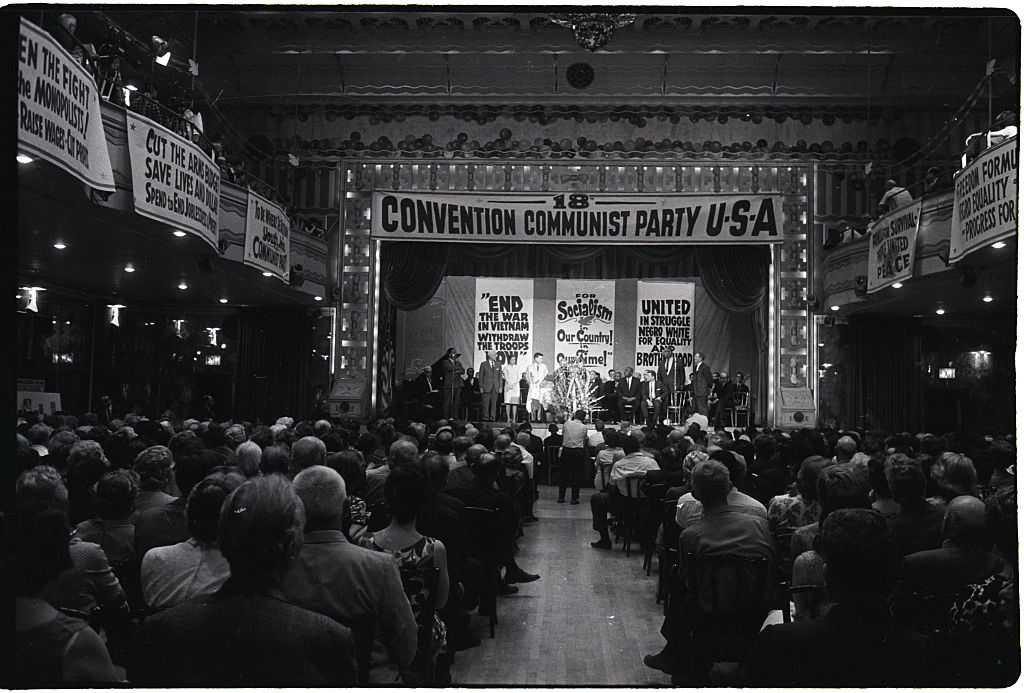
CPUSA members listen as Gus Hall addressed the opening day of the National Convention of the Communist Party, New York, June 22, 1966. (Bettmann Archive via Getty Images)
After several years away, I moved back to New York City in 1966. This time it would be permanent. I took the first job offer I had in New York: as an editor at International Publishers, the book publishing arm of the Communist Party (CP). I hadn’t yet joined the Party. I had joked with friends of mine who were Party members that I’d follow Dr. W. E. B. Du Bois’s lead and join when I was in my nineties.
My history with the Party, or at least with its leadership, was a checkered one. About the same time I went to work at the publishing house, I launched the Tri-Continental Information Center, which published a monthly newsletter, organized public forums, and distributed news and reports about the liberation struggles in southern Africa, the Middle East, southeast Asia, and Latin America. The name of the center was inspired by the Organization of Solidarity with the Peoples of Asia, Africa and Latin America (OSPAAAL), based in Havana.
The CP leadership took a mainly jaundiced view of this activity. Holding fiercely to a vulgar caricature of class struggle and revolution as being led by “workers at the point of production,” they offered verbal support to the liberation struggles in these countries but did little to aid them. (One exception was in the case of Vietnam, where the Soviet Union was a lifeline to the Vietnamese resisting the US barbarism.)