Puerto Rico’s Electricity Nightmare Was Brought to You by Privatization
For years, Puerto Rico has endured a ruthless campaign of austerity and privatization, including a corporate takeover of its once-public power grid. The result: nearly a quarter-million people have been without power for over two weeks since Hurricane Fiona.
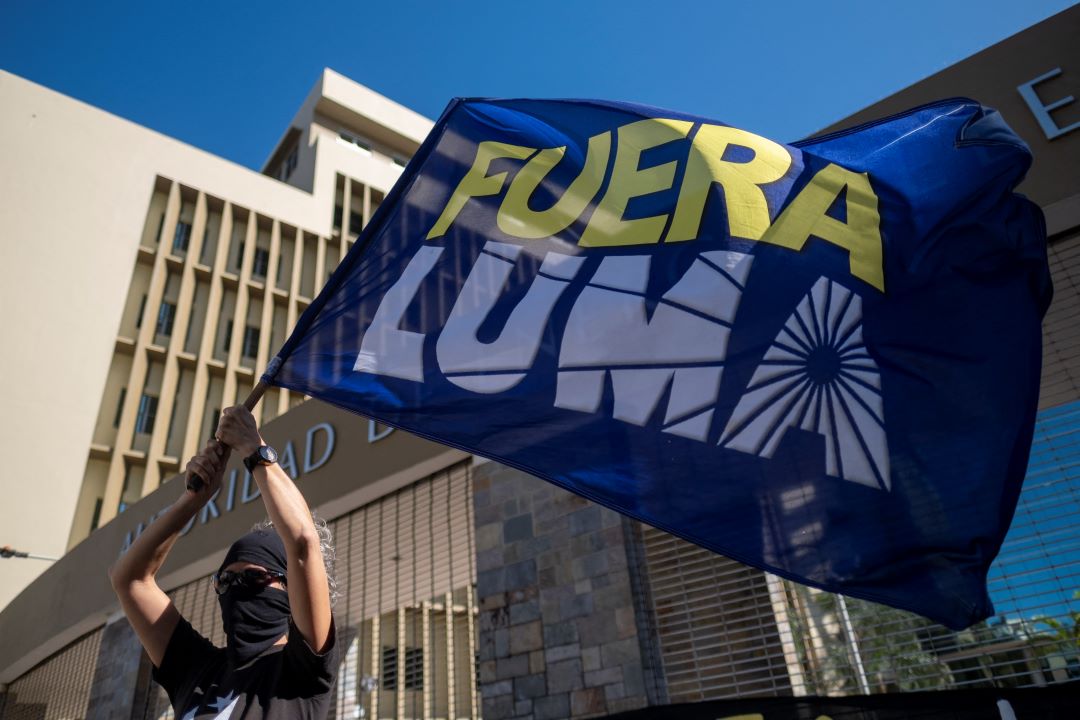
A woman waves a flag that reads in Spanish “LUMA Out” during a protest in front of the headquarters of LUMA Energy, the company that took over the transmission and distribution of the island’s electric authority, after a blackout hit the island two days earlier, in San Juan, Puerto Rico, April 8, 2022. (Ricardo Aduengo / AFP via Getty Images)
Over two weeks since Hurricane Fiona’s landfall in southwest Puerto Rico, nearly a quarter of a million people are still without power. In addition to damaged transit infrastructure, Puerto Ricans are experiencing prolonged disruption to utilities like wireless internet, phone service, and clean water. Though water plants, sewers, and phone lines have sustained some damage in the Category 1 hurricane, the primary bottleneck for these disruptions can be traced to one common denominator: LUMA Energy.
Puerto Rico’s energy sector hasn’t been overseen by a government department since 2014. The energy industry is now controlled by the independent Puerto Rico Energy Bureau (PREB), which oversaw the privatization of the formerly publicly owned power grid, approving a fifteen-year contract for LUMA.
The bureau has a directive to carry out the Puerto Rico Energy Public Policy Act, a mandate which requires 40 percent of all energy to be renewable by 2024, among other environmental goals. The Public Policy Act is an important step toward the modernization of the grid, with some experts identifying centralized fossil fuel plants and their resultant miles-long cable network as the root cause of distribution problems. The prudent thing to do, Tom Sanzillo of the Institute for Energy Economics and Financial Analysis argues, would be to expand the grid’s solar capacity through a decentralized user-operator network.