The Self-Determination Act Could Finally End US Colonization of Puerto Rico
For more than 120 years, the US has colonized Puerto Rico. But a new bill cosponsored by Alexandria Ocasio-Cortez would finally give Puerto Ricans the chance to decide their political relationship with the United States — and recognize their right to self-determination.
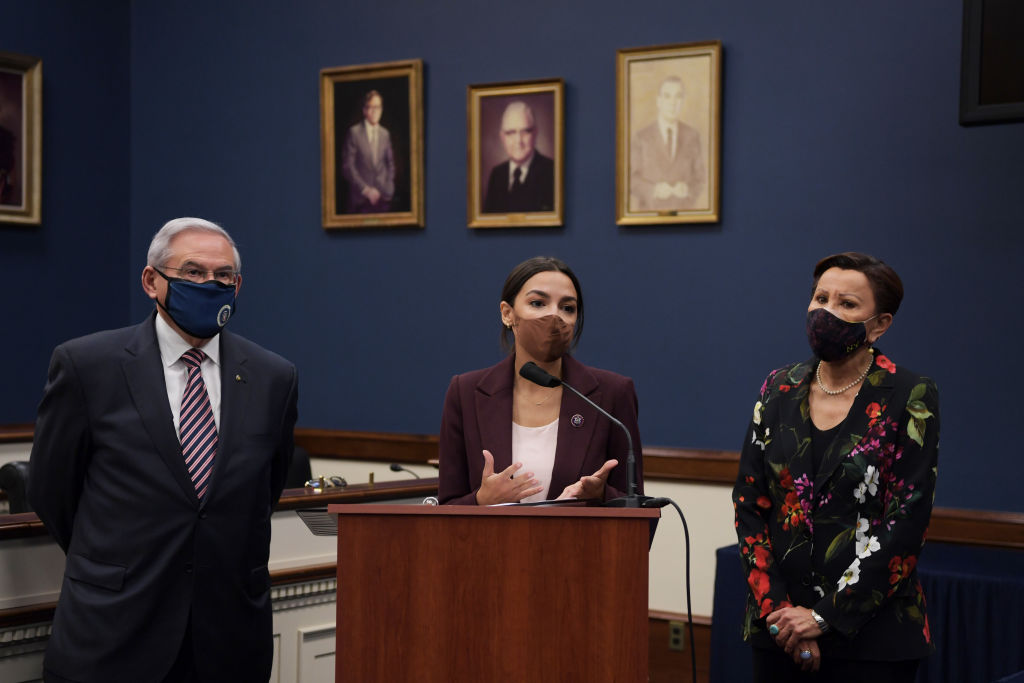
New York Democratic Reps. Alexandria Ocasio-Cortez and Nydia Velazquez and New Jersey Democratic Sen. Bob Menendez during a press conference on the Puerto Rico Self-Determination Act of 2021, on March 18, 2021 in Washington, DC. (Lenin Nolly / NurPhoto via Getty Images)
Last month, New York representatives Alexandria Ocasio-Cortez and Nydia Velázquez — joined by New Jersey’s Bob Menendez in the Senate — introduced the Puerto Rico Self-Determination Act of 2021. If passed, the legislation would create a process for Puerto Ricans to finally determine the nature of their relationship with the United States, which for more than 120 years has colonized the island.
The Self-Determination Act comes as Puerto Ricans are rising up — against a federally imposed fiscal control board, government neglect in the wake of Hurricane Maria, gender and racial violence on the island, and business as usual in local government — making the status quo colonial relationship untenable. The bill correctly recognizes that Puerto Ricans themselves — not their colonial overseers — have the right to determine their own future.
Here is how the law would work. First, the Puerto Rican legislature would pass a law to initiate a status convention. Residents of Puerto Rico would elect delegates to the status convention, who in turn would outline a slate of political status options and accompanying transition plans in consultation with a commission composed of members of Congress and the presidential administration. The political status options could include statehood, independence, free association, or any option other than the current colonial arrangement. The status options, and the accompanying transition plans, would then be put to a vote in a special referendum on the island. Finally, Congress would ratify the selected status option — deferring entirely to the choice of Puerto Rican voters — and the US and Puerto Rican governments would begin to implement the new arrangement.