Ludwig von Mises Was a Free-Market Ideologue, Not a Hardheaded Thinker
Ludwig von Mises, the influential right-wing economist, thought of himself as a sober, scientific critic of socialism. In reality, he was a free-market ideologue, using dressed-up dogma to prove why workers should bow before their capitalist masters.
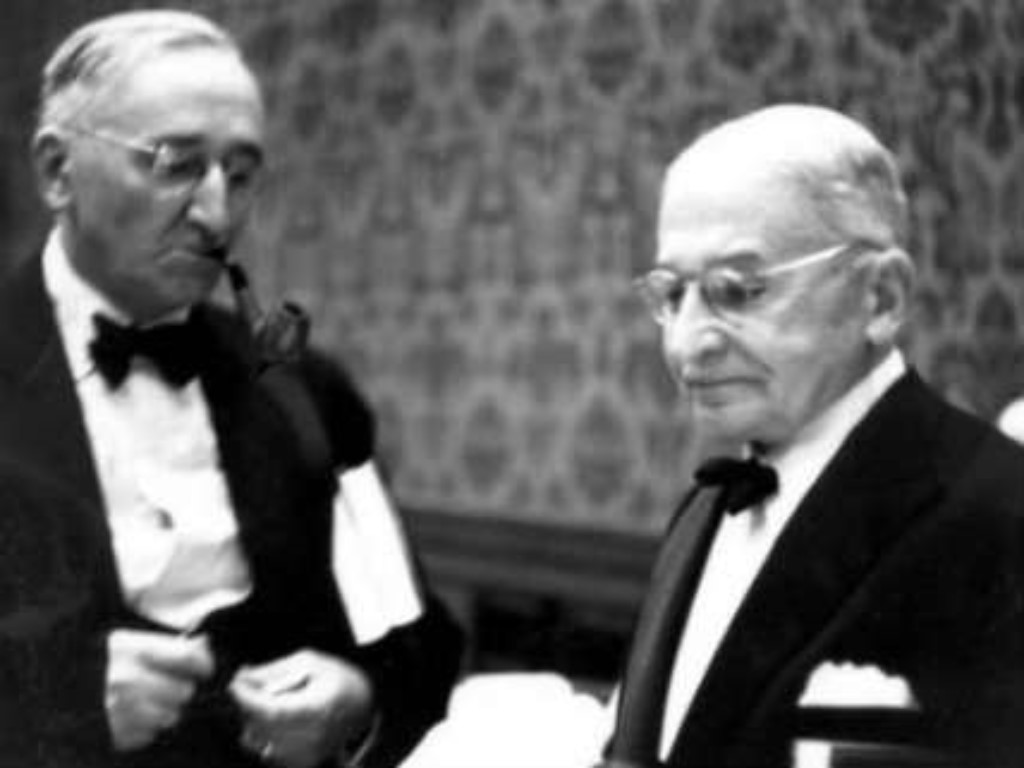
Ludwig von Mises (right) with his student Friedrich Hayek. (Margit Von Mises / Wikimedia Commons)
In his 1922 book Socialism: An Economic and Sociological Analysis, the famed classical liberal Austrian economist Ludwig von Mises presents his analysis as an impartial and sober critique — based on “science” and “utilitarian” evaluations rather than prejudice or moralism. In a telling section, however, Mises lets the mask slip. He excoriates liberals who are willing to allow any state intervention in the economy to advance the general welfare:
It is not possible to compromise, either, by putting part of the means of production at the disposal of society and leaving the remainder to individuals. Such systems simply stand unconnected, side by side, and operate fully only within the space they occupy. . . . Compromise is always only a momentary lull in the fight between the two principles, not the result of a logical thinking-out of the problem. Regarded from the stand-point of each side, half-measures are a temporary halt on the way to complete success.
Rather than a “logical” or “scientific” argument, the overwhelming impression one gets from reading Mises’s many works is unrelenting dogmatism, with more than a touch of xenophobia and elitism. (“You have the courage to tell the masses what no politician told them: you are inferior and all the improvements in your conditions which you simply take for granted you owe to the effort of men who are better than you,” Mises wrote to Ayn Rand in 1958, praising her free-market treatise Atlas Shrugged). A kind of bizarro vulgar Marxist, Mises really did just think liberalism was a synonym for the ideological defense of private property.