Britain’s Political Crisis Is Further Proof That It Is a Nation in Decline
The UK’s former prime minister Liz Truss came to power promising to restore growth to the British economy. During her 45 days at the helm, she crashed it. Calamity is pending, and the country’s political elite are out of ideas.
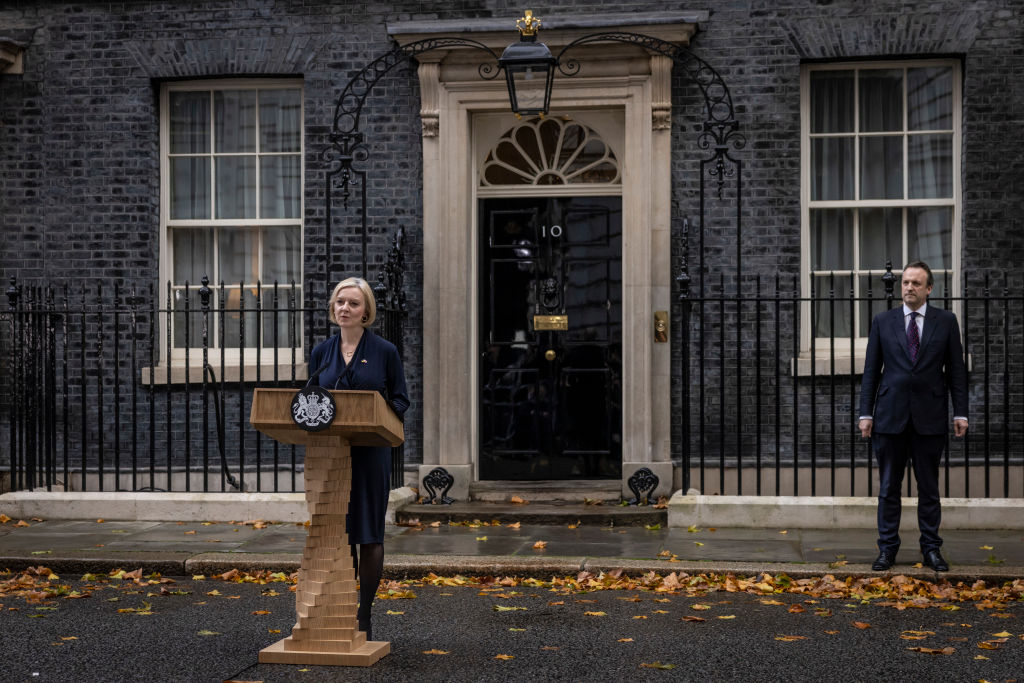
Liz Truss speaks at Downing Street as she resigns as Prime Minister of the United Kingdom on October 20, 2022 in London, England. (Dan Kitwood / Getty Images)
In 1832, before the passage of the Great Reform Act, the enfranchised population of Great Britain stood at an estimated four hundred thousand men. Liz Truss, the country’s shortest-serving prime minister following her resignation this Thursday around lunchtime, was elected to the role by less than half as many people: 141,000 registered members of the Conservative Party. Favoring expediency this time, Sir Graham Brady, as head of the 1922 Committee — the rule-setting group of backbench Tories — has opted for a streamlined version of this summer’s election; the next prime minister is likely to be declared on Monday following a nomination process conducted among the Party’s 357 current MPs. By the end of the year, we might expect the cabinet to decide the matter among themselves every other week to spare the remaining sixty-seven million Britons the hassle.
MPs favor Rishi Sunak, chancellor of the exchequer under Boris Johnson and former hedge fund manager at Goldman Sachs, whose personal wealth stands at £730 million. At the time of writing his competition is Penny Mordaunt, former Royal Naval reservist and unhinged culture warrior, and Boris Johnson — who on exiting office compared himself to the Roman general Cincinnatus, who returned to power as a dictator. Whoever is handed the keys to Downing Street, the financial shocks induced by Truss (forty-five days in office) and her chancellor of the exchequer Kwasi Kwarteng (thirty-eight days in office) have severely constricted the parameters of British politics.
On September 23, in the aftermath of the ghoulish national carnival precipitated by the death of Queen Elizabeth, Kwarteng published “The Growth Plan 2022,” to all intents and purposes a mini-budget: a broad wave of tax cuts whose aim was — you guessed it — to produce economic growth. Most controversially, though least consequentially, Kwarteng scrapped the top rate of income tax while also reducing levies on investment, meting plans to push welfare recipients more aggressively into work, and axing plans made by the Johnson administration to increase corporation tax.