The Strange Odyssey of Britain’s Revolutionary Communist Party
The contrarian website Spiked is now at the heart of an influential right-wing network in British politics and media. But the group behind Spiked started off as an avowedly Marxist organization before turning its back on left-wing politics in the 1990s.
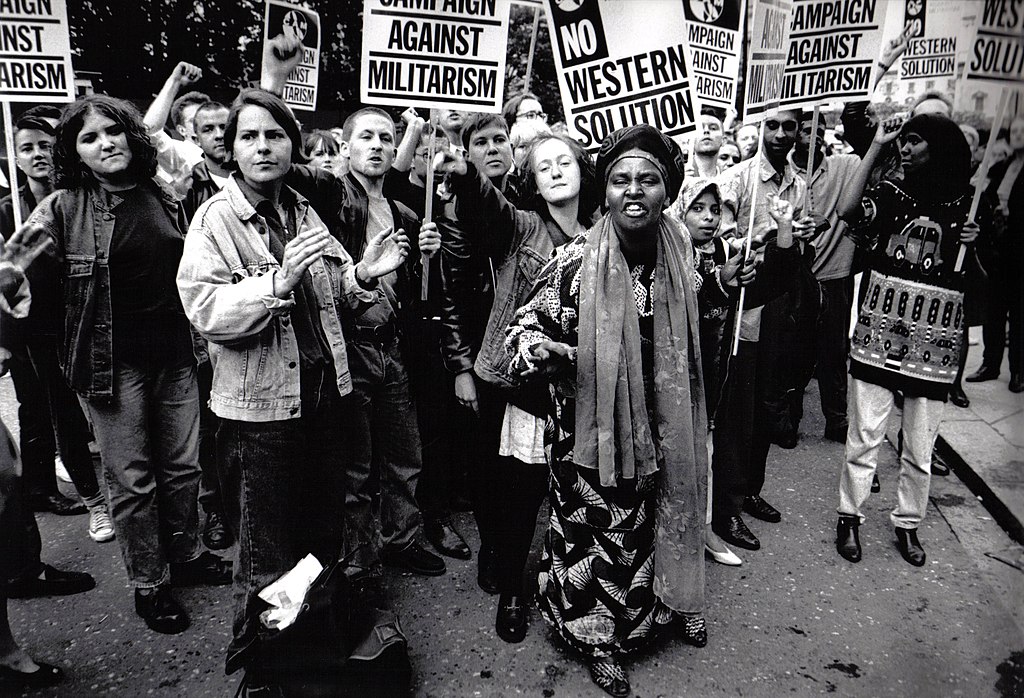
A Campaign Against Militarism protest in 1994. (Murray McDonald / Wikimedia Commons)
In May of this year, Professor Frank Furedi appeared on stage at the National Conservatism conference in London, an event that brought together leading figures of the populist and hard right in Britain. Furedi had recently taken up a position as executive director of the Orbánite thinktank MCC Brussels, and he has been a contributor to right-wing publications such as the Daily Telegraph, the Daily Mail, and the Spectator.
This all seems like a far cry from Furedi’s previous role as a leading figure of the Revolutionary Communist Party (RCP). But several of the RCP’s former members are at the heart of an “anti-woke” network clustered around the contrarian website Spiked. RCP veterans like Mick Hume and Claire Fox, a former Brexit Party MEP and now a House of Lords peer, have become firmly part of the right-wing milieu in Britain today.
The history of the RCP is often written through the lens of Spiked, seeking to explain the trajectory from the far left from the hard right that many leading figures of the group took between the 1970s and the 2010s. But the story of the RCP, from its beginnings in 1976 to its end two decades later, is not just an origin story for a certain coterie of anti-woke figures today. It is also an interesting case study of how the British left fragmented in the 1970s and ’80s against the backdrop of Thatcherism.