How the Russian Left Survived in a Post-Soviet World
- Giuliano Vivaldi
After the demise of the USSR on December 26, 1991, the Russian left had to find its place in a society transformed beyond recognition. In the face of huge challenges, its activists have led important struggles against the system established by Yeltsin and Putin.
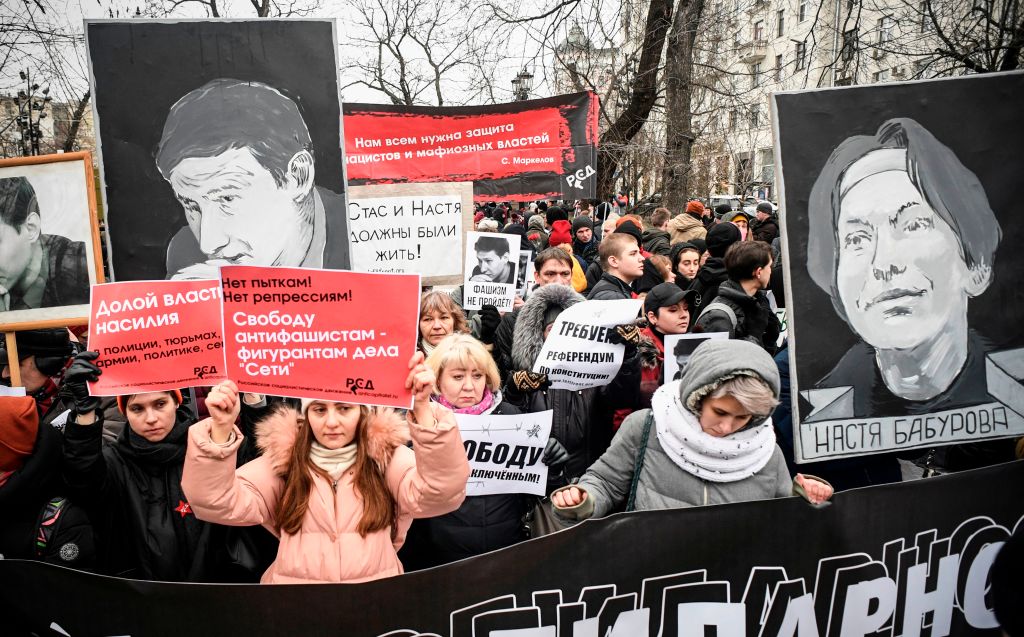
Russian protestors in central Moscow carry portraits of lawyer Stanislav Markelov and journalist Anastasia Baburova, gunned down by neo-Nazis, and a placard that reads “fascists kill, the authorities cover it up,” on January 19, 2020. (ALEXANDER NEMENOV/AFP via Getty Images)
The story of the modern left movement in Russia begins in the late 1980s, during the era of perestroika. From the very beginning it carried a contradictory combination of two political tendencies of the late Soviet period: popular (anti-market, statist) Stalinism and democratic socialism; nostalgic idealization of the USSR and criticism of it from the left. These political tendencies entered the public political arena in the late 1980s, and immediately found themselves on opposite sides of the battlefield dividing supporters and opponents of Mikhail Gorbachev’s perestroika.
The non-Stalinist left, originally part of the general democratic movement, created a number of independent organizations in 1989–1991, including the Confederation of Anarcho-Syndicalists, which became the first prominent and rather sizable anarchist group in the post-Soviet space, and the Committee for Workers’ Democracy and International Socialism, the first Trotskyist group. These and other antiauthoritarian left-wing groups, mainly arising among students, focused their efforts on establishing contacts with the growing labor movement and the newly emerging independent trade unions.
Boris Yeltsin’s victory in August 1991, the collapse of the Soviet Union, and the beginning of aggressive market reforms finally split the amorphous democratic movement: its rightward, liberal wing actively supported the new government, while the antiauthoritarian left moved into the ranks of the radical opposition. The very logic of events pushed this sector of the Left to participate in the emerging mass movement against market shock therapy, a movement dominated by Stalinists.