In Russia, Communists Are Standing Up Against Putin’s Fraud
In Russia’s general election, the Communist Party surged to a strong second place. But the party’s rise has also made it a target for Vladimir Putin’s government — including through Putin's massive interference in the electoral process.
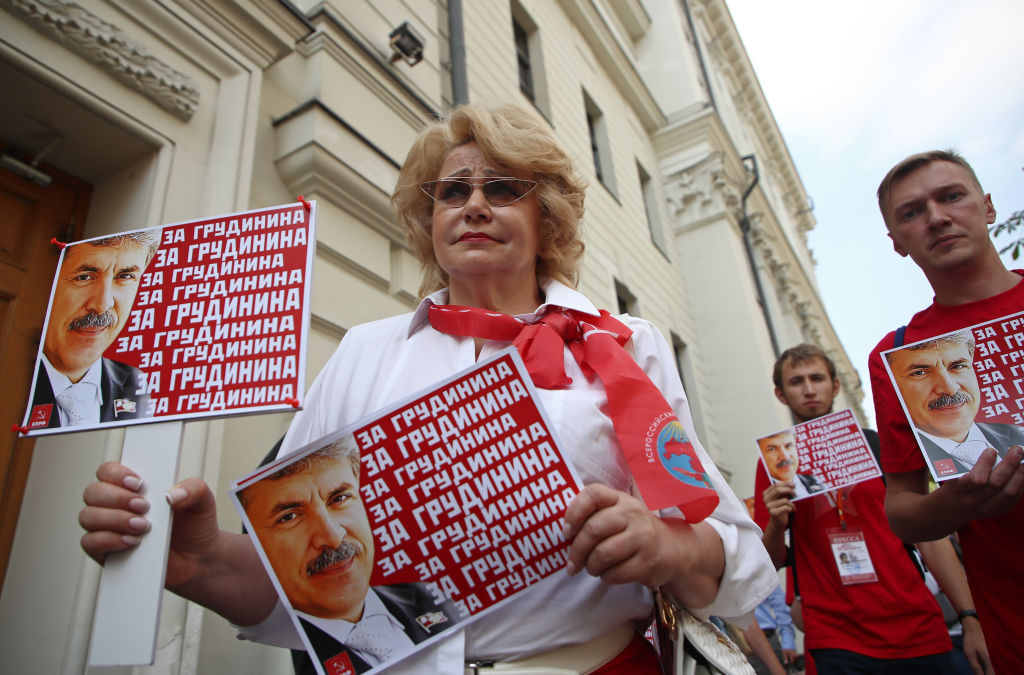
Supporters of the Communist Party of the Russian Federation (KPRF) protest the Central Election Commission’s decision to remove KPRF candidate Pavel Nikolayevich Grudinin from the federal list of election candidates. (Anton Novoderezhkin / TASS via Getty Images)
At first glance, Russia’s political landscape remains unchanged after the general election. The contest brought an easy victory for the pro–Vladimir Putin coalition, buoyed by the president’s continued bases of support as well as state harassment and repression against his most visible opponents.
Official results released on September 24 showed that Putin’s brand of nationalism, conservatism, and statism remains hegemonic. While the flagship pro-Putin party United Russia fell slightly below 50 percent support, losing nineteen legislators in the Duma (parliament), it still took 324 out of 450 seats. The main advance was for the Communist Party of the Russian Federation (KPRF), which took 19 percent of the total vote — its strongest score since 2011 — and elected fifty-seven deputies (up fifteen). Among other parties, the social-democratic “A Just Russia” took 7.5 percent, the centrist “New People” 5 percent, and the far-right Liberal Democratic Party of Russia its worst showing in recent history, with 7.5 percent backing.
With this result, United Russia retained its Duma “supermajority” — a two-thirds parliamentary majority enforcing the dominance of Putin’s government and allowing it to make further constitutional changes. However, United Russia’s partial setbacks, the peculiarities of the new electoral system, and the legal and political persecution against a strengthened Communist KPRF, all point to a changing political landscape.